“`html
Standard Fan Box Load Limits — What NEC 314.27 Actually Says
As someone who’s spent the last eight years reviewing electrical installations across the Pacific Northwest, I’ve seen exactly one scenario kill a contractor’s schedule: a 60-pound ceiling fan crammed into a standard pancake box that’s rated for 50 pounds maximum. The inspector shows up, measures the deflection, and the whole thing gets red-tagged.
Here’s the actual rule, and it hasn’t budged in years. NEC Article 314.27(D) states that boxes and conduit bodies shall be securely fastened and supported — at least if you want them to pass inspection. For ceiling-suspended fixtures and ceiling fans, the allowable weight is 50 pounds for standard outlet boxes without supplemental bracing. That’s it. No negotiation. No “well, the fan feels secure.” Fifty pounds, measured and calculated by the load you’re hanging.
Why 50? It comes down to box design. Standard outlet boxes — whether old-work or new-work models — use 6-32 mounting screws into the box ears. The shear strength of those fasteners, combined with the box material thickness (typically 0.9 mm steel), maxes out at 50 pounds before deflection becomes a concern. During final walkthrough, inspectors actually look for visible brace deflection and screw pull-through as red flags.
The 2023 NEC didn’t change this load limit. Still 50 pounds. What did shift was clarification around supplemental support requirements — more on that in a moment. Older code versions? Identical on this point. Even if your jurisdiction is running 2020 NEC, you’re bound by the same 50-pound rule.
One distinction that matters: new-work boxes rated for fan support come with factory-installed braces that add rigidity, but they still top out at 50 pounds without additional reinforcement. Old-work retrofit boxes — the pancake-style models used in existing ceilings — often come without any brace at all. Those are the death traps. I made that mistake once on a 2015 retrofit. Learned the hard way.
How to Calculate Actual Load Your Ceiling Fan Box Can Hold
This is where contractors stumble.
The 50-pound limit isn’t just the fan motor. You add: fan blade assembly weight, the light kit (if installed), the down rod, and any custom trim. A typical 52-inch fan weighs 40–50 pounds bare. Add a 10-pound LED light kit. Add a 2-pound down rod. You’re at 52–62 pounds before you even energize it. That standard box fails immediately.
I built a quick reference table for my crew based on what we actually see in the field:
- Small 36-inch fan: 25–30 lbs (fits in standard box with light kit)
- Mid-range 52-inch fan: 40–50 lbs (standard box fails with light kit)
- Large 60-inch fan: 50–65 lbs (requires reinforcement in nearly all cases)
- Industrial 72-inch ceiling fan: 70+ lbs (always requires heavy-duty brace or solid mount)
To calculate the actual load on your box: pull the fan spec sheet. Write down the motor and blade assembly weight. Check if a light kit is specified in the design — if so, get its weight from the fixture spec. Add the down rod weight (standard rods run 1–3 pounds; heavier decorative rods can hit 5–8 pounds). Sum those numbers. That’s your load.
On-site, visual identification matters. If you’re in an existing house and the fan’s already installed, you can tell box type by looking at the brace configuration. A standard outlet box has a simple bracket nailed or screwed to a joist. A heavy-duty fan brace looks like an adjustable metal bar with multiple mounting points — it’ll span across two joists or a wider area. If there’s no visible brace structure and you’re looking at a flat pancake box, you’re in trouble with anything over 35 pounds.
Probably should have opened with this section, honestly. Most code callbacks I see are because someone eyeballed the fan weight instead of actually checking the spec sheet.
Reinforcement Options When You Exceed Box Limits
Three solutions exist. Know the cost and labor time for each before you quote the job.
Option 1: Heavy-Duty Fan Brace (Retrofit Old Work Brace)
If you’re upgrading an existing installation, an Old Work Brace rated for 100+ pounds runs $30–$60 per unit. Arlington Industries OWT50 and Raco Old Work Brace are the names you’ll see on invoices. Installation takes 15–30 minutes. You’re removing the existing box ears, sliding the brace into the joist cavity, and securing with lag screws — 3/8-inch × 2.5-inch minimum, Grade 2 or better. The brace compresses against two joists, spreading the load across a wider area. NEC 314.27(D) explicitly allows this. Supplemental bracing increases the allowable load to 100+ pounds depending on brace rating.
This works for retrofits. For new construction, use a box with an integrated heavy-duty brace from the start.
Option 2: Heavy-Duty New-Work Box with Integrated Brace
For new installations, specify a box designed for ceiling fans during the rough-in stage. Examples: Carlon Ceiling Fan Box (Southwire), Hubbell Heavy-Duty Fan Box. These cost $15–$25 each and come with reinforced ears and a factory-integrated brace rated for 100+ pounds. No retrofit work needed. Install the box during framing, secure the brace to solid framing — not drywall — and you’re compliant with NEC 314.27(D) without additional reinforcement. This is the inspector’s favorite approach. No field modifications, and factory engineering backs the installation.
Option 3: Solid Framing Mount (No Box)
For very heavy fans — 60+ pounds or custom installations — mount the fan directly to a solid 2×4 or 2×6 blocking installed between joists. Secure the fan mounting bracket with lag screws or bolts. 1/2-inch minimum Grade 2 bolts for fans over 60 lbs. An electrical box still feeds power to the light fixture (if present), but the mechanical support comes entirely from framing, not the box. This costs more labor — additional framing work — but guarantees zero load-path issues. Many inspectors prefer this for commercial installations or when fans exceed 75 pounds.
Fastener upgrades are critical here. Standard 6-32 mounting screws fail under heavy loads. Step up to 1/4-inch lag screws or bolts with washers if you’re using supplemental bracing. Nylon anchors and toggle bolts are insufficient. Solid into wood or metal only.
Common Installation Failures That Exceed Weight Limits
Guided by field experience, here are the failure modes inspectors actually flag.
Oversized Fan in Standard Box (Most Common)
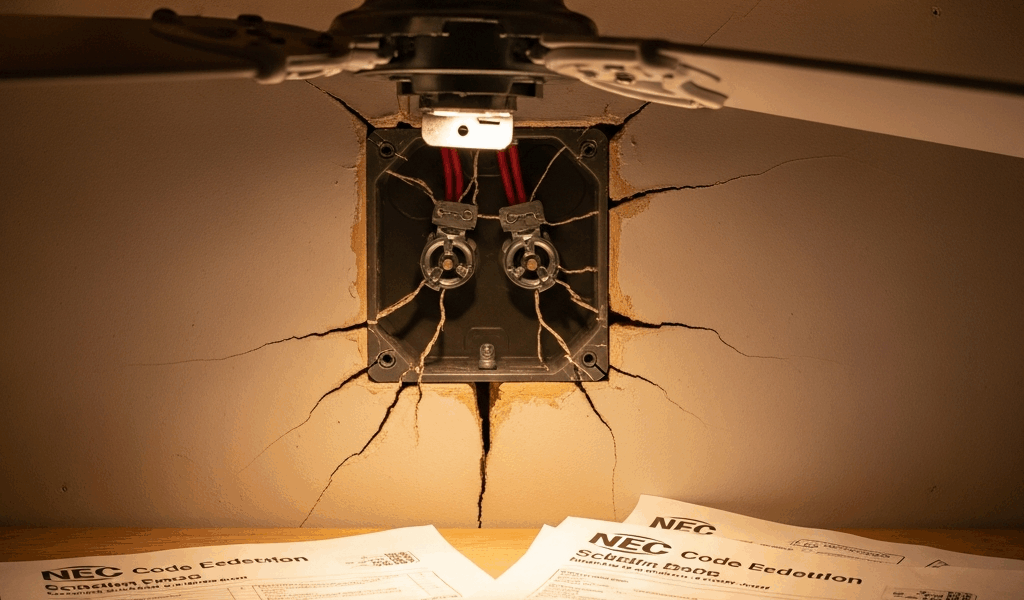
Contractor installs a 58-pound fan into a standard pancake outlet box. Homeowner powers it on. After a few months of operation, vibration loosens the mounting screws. The box deflects visibly — you can see a 3–5 mm flex in the drywall around the fixture. Inspector measures deflection and finds brace screw pull-through. The screw holes have enlarged, indicating load failure. Red tag. Cost to retrofit: $200–$400 labor plus materials for a heavy-duty brace.
Old House with Compromised Joists
You’re installing a 45-pound fan in a 1970s home. The joist is dry-rotted or partially compromised by old water damage. Standard mounting procedures assume solid framing with 1.5-inch bearing surface. Compromised wood cannot provide that. The mounting brace flexes excessively, screw holes strip, and the fan becomes a sag risk. Solution: sister a new 2×8 to the existing joist or use a full-span blocking approach. This adds labor but eliminates the structural failure mode.
Incorrect Brace Installation
Brace installed but not secured to solid framing — maybe just nailed to one joist instead of spanning two, or fastened to drywall backing instead of wood. Under load, the brace twists or the mounting points pull away from framing. Same outcome: visible deflection, screw failure, red tag. This is pure installation error. The solution is re-installation with proper fastening into solid joist material on both sides of the span.
Adding Fixture Weight After Initial Install
Original plan: 40-pound fan, no light kit. Box is fine. Later, homeowner or contractor adds a 12-pound recessed light fixture to the same box. Now you’re at 52 pounds on a box rated for 50. The load creeps past the limit without anyone recalculating. Inspection catches it during a general electrical review. Lesson: recalculate total supported load every time the fixture configuration changes.
Inspectors look for two specific red flags: (1) visible brace deflection measured against an adjacent drywall edge, and (2) evidence of screw pull-through, where the screw holes have enlarged or the mounting ears show permanent deformation. Either one triggers a violation.
Check Your Local Code — NEC Adoption Varies
The NEC is a model code. Your Authority Having Jurisdiction (AHJ) — your city, county, or state electrical authority — may adopt the current 2023 NEC, an older version (2020, 2017, 2014), or a version with local amendments.
Before you start a fan installation, check your AHJ’s adopted code year and any published amendments. Many jurisdictions post this information online. Search “[Your City] adopted electrical code” and you’ll often find it within a few clicks. Some older adoptions still reference the 50-pound limit with slightly different wording — the practical outcome is identical, but the citation number may vary. A few jurisdictions have local rules adding supplemental support requirements for fans over 40 pounds regardless of box type. Those are more restrictive than NEC, and you must follow them.
One professional habit: keep a printed copy of your AHJ’s adopted NEC code year and any amendments in your truck or office. Reference it during the pre-job meeting with the contractor or property owner. It prevents disputes during inspection and protects you if questions come up later.
“`




Stay in the loop
Get the latest northwest electric pros updates delivered to your inbox.