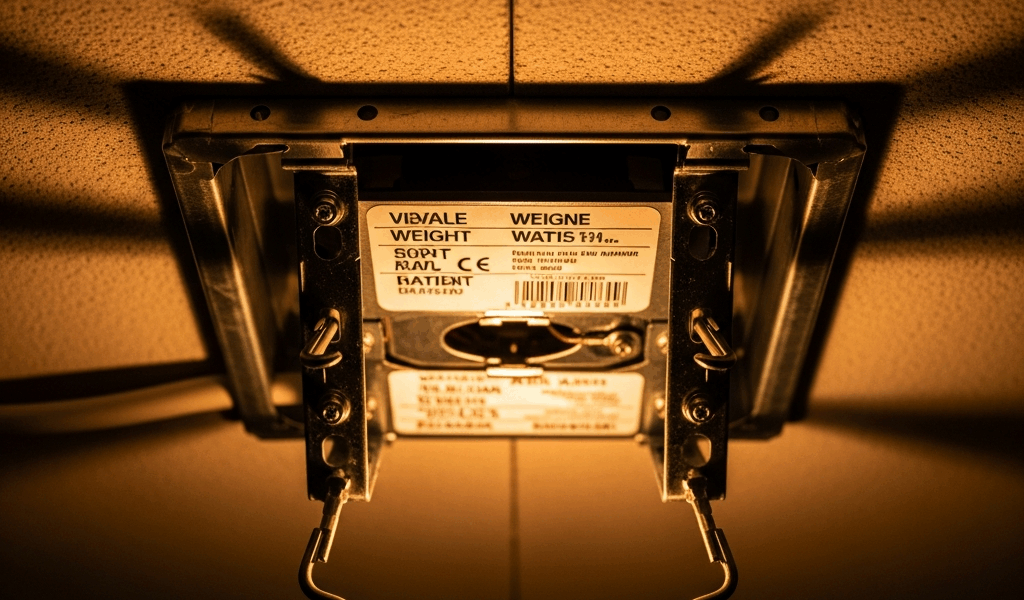
Quick answer: A ceiling fan cannot be supported by an ordinary light-fixture box merely because the fan weighs less than 50 pounds. When the outlet box or box system is the fan’s sole support, NEC 314.27(C) requires it to be listed and marked by the manufacturer as suitable for ceiling-suspended fan support. Follow the marked maximum, the fan manufacturer’s instructions and local code.
Under the NEC text discussed below, a listed fan-support box or box system cannot be used as the sole support for a fan over 70 pounds. When a listed system is designed for a fan over 35 pounds, its marking must state the maximum supported weight. A fan can also be supported independently by appropriate building structure when installed under the applicable instructions and local approval.
What NEC 314.27(C) actually requires
The ceiling-fan rule is about the support method, not a generic “standard box weight limit.” For a ceiling-suspended paddle fan supported solely by an outlet box or outlet-box system, the assembly must be:
- listed for the application;
- marked by the manufacturer as suitable for fan support;
- installed according to its listing and instructions; and
- used within the marked fan-weight limit.
The NEC language establishes a 70-pound upper boundary for an outlet box or box system used as the fan’s sole support. It does not make every box safe below 70 pounds. A box with no fan-support marking is not converted into a fan box by adding washers, larger screws or an unsupported brace.
Code editions and local amendments vary. The authority having jurisdiction—usually the local electrical inspection or building department—determines the adopted rules for a project. Existing installations may also be governed differently from new work. Confirm local requirements rather than assuming the newest model-code edition applies automatically.
The 35-pound and 70-pound numbers explained
These two figures are often misquoted:
- 35 pounds: when a listed box or box system is designed to support a fan heavier than 35 pounds, NEC language requires the marking to include the maximum fan weight it can support. This is not permission to hang any fan of 35 pounds or less from an unmarked light box.
- 70 pounds: the NEC does not permit an outlet box or box system used as the fan’s sole support to support a fan heavier than 70 pounds. Heavier fans require another approved support method, normally described by the fan manufacturer and reviewed under local requirements.
Use the fan’s actual installed weight from its manual or specification—not shipping weight and not a guess based on blade diameter. Include the configuration the manufacturer says counts toward supported fan weight. Light kits and accessories must be compatible with the fan and support system under their instructions.
Fan-rated is not the same as heavy-duty
A generic “heavy-duty,” deep or metal box is not necessarily listed for the dynamic loading of a rotating fan. The useful evidence is the product’s listing, fan-support marking, model number and installation instructions.
Material alone does not decide suitability. Both metallic and nonmetallic products can be evaluated and listed for their intended use. For example, Hubbell/RACO publishes a nonmetallic Saddle-Box model that is UL listed and rated for a 70-pound ceiling fan when installed as directed. Therefore, “all plastic boxes are prohibited” is incorrect.
Likewise, a metal box is not automatically fan-rated. Old fixture boxes, shallow boxes, remodel boxes and brace bars vary widely. Never infer a fan rating from appearance.
How to identify the support safely
The most reliable path is documentation. Check the fan installation manual, any visible box marking, the box/brace model number, and the manufacturer’s current instructions. If the rating cannot be verified without removing an energized fixture, stop and use a qualified electrician.
Before opening a canopy or box, the circuit must be de-energized and verified with appropriate test equipment by someone qualified to perform the work. Turning off a wall switch is not enough. Ceiling boxes can contain additional circuits or switched conductors.
A qualified inspection should determine:
- whether the box or box system is listed and marked for fan support;
- its exact fan-weight marking and model instructions;
- whether a brace or structural connection is installed as designed;
- whether the fan is independently supported from framing instead of relying on the box;
- whether the fan’s mounting hardware matches its instructions; and
- whether wiring, grounding, box fill and local permit requirements are satisfied.
A hand “wiggle test” or applying downward force does not prove a listing, hidden fastener condition or structural capacity. Do not test an installed fan by pulling on it.
Warning signs that require immediate attention
Stop using the fan and arrange inspection if you observe:
- the canopy separating from the ceiling;
- the entire mounting point moving relative to the ceiling;
- new scraping, arcing, burning odor, smoke or discoloration;
- damaged conductors or loose electrical connections;
- loose mounting hardware that returns after correction; or
- a box or brace visibly pulling away from framing.
Ordinary blade imbalance can cause wobble without proving that the box is failing, and electrical hum can have several causes. Those symptoms still deserve diagnosis; they should not be used to invent a structural or fire cause without inspection.
If there is smoke, active arcing or a burning odor, leave the area, shut off power only if it is safe to do so, and contact emergency or electrical professionals as appropriate.
When an upgrade is required
Replace or change the support method when the existing system cannot be verified as suitable, the fan exceeds its marked rating, components are damaged, or the installation does not match the product instructions and adopted code.
Common listed solutions include a box fastened to suitable framing, a listed fan brace-and-box system installed between framing members, or manufacturer-directed independent structural support. Which solution fits depends on framing, ceiling finish, box fill, wiring method, fan weight and local requirements.
Do not improvise structural fasteners through an electrical box, reuse unspecified mounting screws, mount to drywall alone or assume a generic expanding brace is fan-rated. Use all components supplied or specified by the listed system.
Heavy fans and unusual ceilings
For fans above the listed box-system limit, unusually long downrods, sloped or vaulted ceilings, outdoor/wet locations, suspended ceilings, masonry, historic construction or damaged framing, obtain the fan manufacturer’s required support details and qualified local review. A structural engineer is not automatically required for every fan over a generic threshold, but unusual loading or framing can justify one.
Outdoor fans and boxes must also be suitable for the environment. A product’s indoor fan rating does not establish weather resistance. Follow both the fan and box listings.
Ceiling fans versus luminaires
NEC 314.27 contains separate provisions for luminaires and ceiling-suspended fans. A product may carry different marked limits for a light fixture and a fan. Hubbell product examples, for instance, publish distinct fan and luminaire ratings for the same box.
Do not apply a high luminaire rating to a rotating fan. Confirm the line specifically labeled for ceiling-fan support.
Homeowner decision checklist
- Find the exact fan model and installed weight.
- Locate documentation for the box, brace or structural support.
- Confirm an explicit listing/marking for ceiling-fan support.
- Confirm the fan is within the marked fan—not luminaire—rating.
- Check that installation matches every manufacturer instruction.
- Check the locally adopted electrical code and permit/inspection rules.
- Use a qualified electrician when the support cannot be verified safely.
If your immediate question is how to recognize an existing box rather than interpret the weight rule, see how to determine whether a ceiling location is fan-ready. That inspection still depends on labels and instructions, not appearance alone.
Frequently asked questions
Can a standard electrical box hold a ceiling fan?
Only if the actual support method complies with the applicable fan-support rules. If the box or box system is the fan’s sole support, it must be listed and marked as suitable for ceiling-fan support. An ordinary unmarked light box is not acceptable merely because the fan is light.
Is every fan box rated for 70 pounds?
No. Seventy pounds is the NEC upper limit described for an outlet box or box system used as sole fan support, not a universal product rating. Follow the specific marked maximum.
What happens above 35 pounds?
For a listed box or box system designed to support a fan above 35 pounds, the required marking includes its maximum supported fan weight. Verify that marking and instructions.
Can a plastic box support a fan?
Material alone does not decide. A nonmetallic box can support a fan when it is specifically listed, marked and installed for that use. An ordinary plastic fixture box cannot.
Does a fan need a dedicated circuit?
Fan-support rules do not create a universal dedicated-circuit requirement. Circuit capacity, controls, other loads and manufacturer instructions must be evaluated separately under the adopted code.
Authoritative references
- Leviton Captain Code: NEC 314.27(C) fan-support box requirements
- NFPA code-development record: 314.27(C) text and structural-support clarification
- UL Solutions: outlet-box testing and certification services
- Hubbell/RACO: example listed nonmetallic 70-pound fan-support box
- Hubbell/RACO: listed fan brace-and-box system example



Stay in the loop
Get the latest northwest electric pros updates delivered to your inbox.