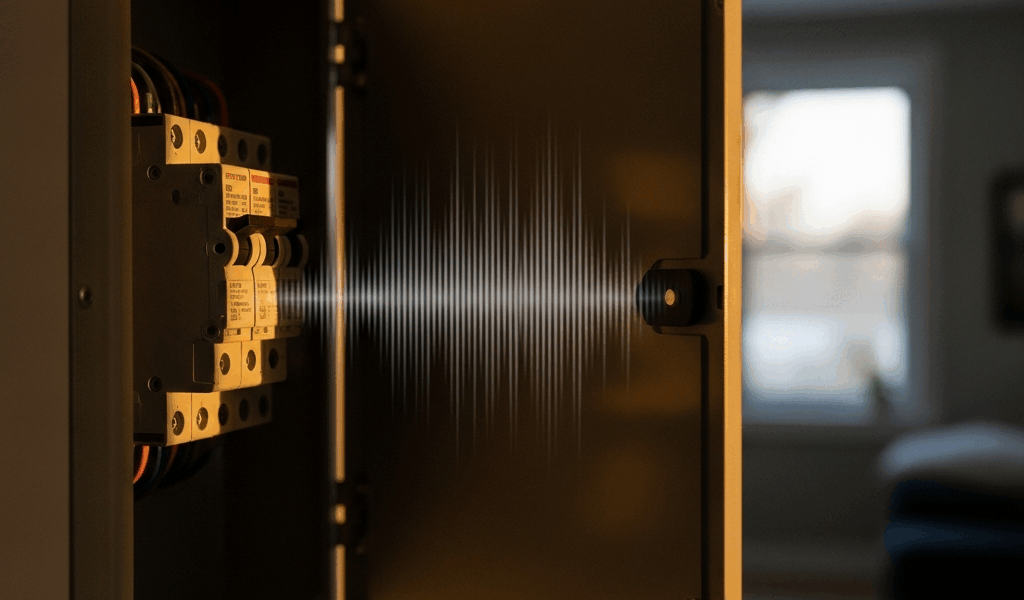
If your electrical panel is buzzing: do not remove the cover or touch wiring or breaker terminals. A faint, steady hum can occur in some equipment, including certain electronic arc-fault breakers, but a new, loud, intermittent, sizzling, crackling, or load-dependent buzz needs evaluation by a licensed electrician.
Leave the area and call 911 for smoke, visible fire, or active sparking. Do not use water on an electrical fire. For a burning-plastic odor, visible scorching, unusual heat, repeated tripping, shocks, or flickering throughout the home, stop troubleshooting and arrange urgent professional help. If you are uncertain whether the condition is safe, treat it as a warning—not as proof of “normal 60 Hz hum.”
Is an electrical panel supposed to hum?
Some electrical equipment can make audible operational noise. Schneider Electric explains that alternating magnetic fields can cause tiny movements in ferrous parts inside a breaker. Its guidance also says loose hardware, wiring, current transformers, doors, or covers can amplify noise. Certain Square D arc-fault breakers contain electronics that may produce a low hum.
That does not mean every breaker box should hum, that an older panel should be louder, or that a homeowner can identify safety from pitch alone. The manufacturer’s guidance is equipment-specific, and its technical bulletin says electrical distribution equipment should be installed, serviced, and maintained only by qualified personnel.
The safest distinction is change and context:
- Possibly operational: a faint, steady sound that the manufacturer documents for that exact breaker or device, with no heat, odor, discoloration, flicker, tripping, or change in volume.
- Needs an electrician: a new or louder buzz, a sound tied to a load, intermittent buzzing, vibration that has changed, repeated breaker operation, or noise whose source is unclear.
- Urgent: sizzling, crackling, burning odor, smoke, sparks, scorching, unusual heat, shocks, or widespread flickering.
The Electrical Safety Foundation International lists unusual sizzles and buzzes, flickering lights, arcs or sparks, hot or discolored components, burning-insulation odor, shocks, and frequent breaker trips as warning signs that warrant a licensed electrical inspection.
Why a breaker box may buzz
The sound alone cannot identify the defect. A qualified electrician may investigate several possibilities.
Normal device-specific operational noise
An electronic breaker, transformer, contactor, or another magnetic component can make a faint hum during operation. The correct benchmark is the manufacturer’s documentation for the exact model—not a general internet rule. If the sound is new, increasing, or accompanied by another symptom, have it inspected.
Loose or resonating hardware
Schneider Electric identifies loose bolts, mounting hardware, doors, covers, wiring, and similar parts as possible contributors to excessive humming. A door or cover can resonate and make a small source sound much larger. Because diagnosing the source can require access inside energized equipment, this is not a homeowner tightening task.
A loose or damaged electrical connection
A compromised connection can create heat, arcing, or thermal damage. The Consumer Product Safety Commission has documented how lost connection force in recalled breaker equipment could lead to excessive temperature, arcing, insulation damage, fire, property damage, or injury. Only an electrician should open the dead front and evaluate terminations, bus connections, breaker fit, and evidence of heating.
A breaker or connected load problem
A sound that begins when a particular appliance or circuit is energized may help an electrician narrow the investigation, but it does not prove a simple overload. Possible causes include the connected equipment, an improper or failing connection, breaker condition, compatibility, or another circuit fault. Do not repeatedly reset a breaker that buzzes or trips.
Arcing in wiring
Arcing can occur from damaged insulation or connections and may not draw enough current for an ordinary breaker to respond immediately. The CPSC’s AFCI guidance explains that conventional fuses and breakers may not respond to early arcing and sparking conditions. Arc-fault circuit interrupters are designed to provide additional protection, but they do not replace inspection of a suspected problem.
What you can safely observe
Keep the panel closed. From a safe distance, without touching it, note:
- whether the sound is faint, loud, steady, intermittent, crackling, or sizzling;
- when it began and whether it is getting louder;
- whether lights dim or flicker at the same time;
- whether a breaker has tripped repeatedly;
- whether the noise coincides with a particular appliance starting;
- whether there is any odor, visible discoloration, smoke, or sparking; and
- the panel and breaker manufacturer/model information visible without removing covers.
This information helps the electrician, but it is not a diagnosis. Do not place your hand on the panel to judge temperature, remove trim, insert a tool, tighten a cover, or use a phone close to active sparking.
Should you reset a buzzing breaker?
Not as a diagnostic experiment. A breaker that has tripped normally must be moved fully to OFF before it can be reset, but buzzing changes the situation. Do not keep cycling a noisy or repeatedly tripping breaker to see whether the problem clears. Repeated resets can re-energize a fault.
If you know which ordinary load caused a one-time overload and there are no warning signs, the appliance can be left off while you consult the breaker and equipment instructions. If the breaker itself buzzes, trips again, feels abnormal, or the cause is uncertain, leave it alone and call a licensed electrician. See our separate guide for a breaker that trips when nothing appears plugged in.
When to request urgent electrical service
Arrange urgent professional evaluation when the noise is new, loud, intermittent, or associated with:
- a burning or hot-insulation smell;
- visible scorching, melting, corrosion, smoke, or sparks;
- a panel or breaker that appears unusually hot;
- flickering or dimming across multiple circuits;
- frequent or immediate breaker trips;
- a shock or tingling sensation from electrical equipment; or
- loss of power or other evidence of a service problem.
Our guide to an electrical panel that seems hot covers the related warning signs, but do not touch a suspicious panel to test it.
What an electrician may check
Depending on the equipment and symptoms, the electrician may verify breaker compatibility and condition, torque and terminations using manufacturer requirements, bus and conductor damage, load current, voltage, signs of arcing or overheating, enclosure resonance, and applicable recalls. Replacement decisions should be based on inspection, listing, condition, and current code requirements—not merely the age or brand name mentioned in an online article.
For broader prevention guidance, review our home electrical-fire warning signs and ESFI’s recommendation that electrical work be performed by a licensed electrician in accordance with applicable codes.
Bottom line
A faint, documented hum from a specific device can be operational noise. A new or pronounced electrical-panel buzz cannot be cleared as safe from sound alone. Keep the cover closed, record what you can observe without contact, and have a licensed electrician inspect it—immediately when heat, odor, smoke, sparks, repeated tripping, shocks, or flickering accompany the noise.



Stay in the loop
Get the latest northwest electric pros updates delivered to your inbox.