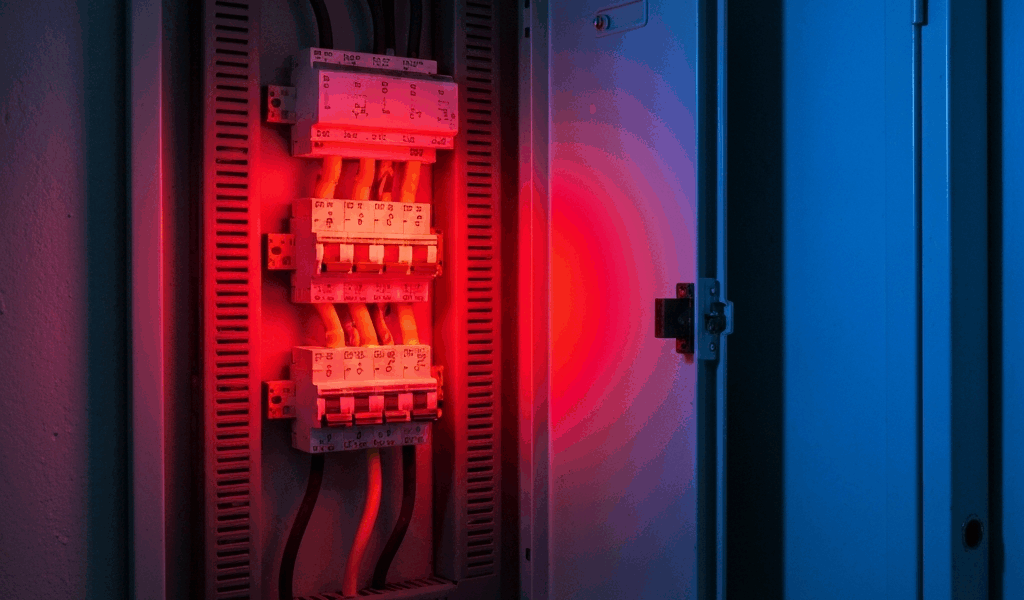
Why Your Panel Gets Warm or Hot
I learned about hot electrical panels the hard way—standing in my basement at 11 PM, hand hovering near the main panel, wondering if I should panic. The breaker box was genuinely too hot to touch. That’s when I discovered most homeowners have no idea what “normal” actually feels like, and the difference between a warm panel and a dangerously hot one can mean the difference between inconvenience and a house fire.
Your electrical panel will naturally generate some heat. Current flowing through conductors creates resistance, and resistance creates warmth. Think of it like a light bulb—the more electricity flowing through, the hotter it gets. But there’s a massive gap between “slightly warm to the touch if you hold your hand there for a few seconds” and “so hot you pull your hand away instantly.” That distinction matters.
If you can’t comfortably keep your palm flat against the panel enclosure for at least 10 seconds, something is wrong. Full stop.
The three most common culprits behind excess heat are loose connections, overloaded circuits, and a failing main breaker.
Loose connections are the sneakiest offender. When bolts connecting wires to the main breaker or bus bars aren’t tight, current has to jump microscopic gaps to complete the circuit. Those gaps create arcing—essentially tiny electrical fires—that generate intense localized heat. You might see scorch marks around the connection point. Or the heat might just radiate outward through the entire panel. I had this exact issue at a rental property in Tacoma. The previous electrician apparently speed-walked through the final inspection. A $15 bolt that needed retightening was creating enough heat to make the whole panel untouchable. Fifteen dollars.
Overloaded circuits work differently. You run a space heater, a hair dryer, and the microwave on the same circuit simultaneously—boom, excessive current, excessive heat. The breaker should trip when this happens. Sometimes it doesn’t trip fast enough. Maybe you’ve got an old breaker that’s lost its sensitivity over time. The panel heats up as a symptom of the overload pushing through.
A failing main breaker is the most serious scenario. This is what should make you pick up the phone. The main breaker shuts off all power to your home in an emergency. When it starts failing—usually from age, corrosion, or repeated thermal cycling—it loses its ability to regulate current flow smoothly. Resistance increases, heat builds, and the breaker itself becomes the problem rather than the solution. Main breaker failure demands a same-day call to a professional.
What You Should Check First
Before you do anything else, do NOT open your panel. I say this because I had a neighbor who did exactly that, and he got a very expensive education in why electricians require licensing.
Here’s what you can safely observe from outside the panel enclosure:
- Discoloration or scorch marks on the metal box itself, especially around the edges or near where wires enter
- A burned plastic smell coming from the panel area—this is an immediate red flag
- Buzzing or crackling sounds when you hold your ear near it (not touching it, just near it)
- Any visible burn marks or blackening on the breakers themselves if the door is clear plastic
- Whether the panel is warm in one specific spot or uniformly hot across the entire surface
Run your hand near the panel—not touching it yet—to sense the heat radiating outward. Move your hand slowly from left to right, top to bottom. Localized intense heat suggests a specific breaker problem. Even heat across the whole panel suggests either overloading or a main breaker issue.
Then check your breaker history. Have certain breakers been tripping repeatedly? Which ones? Write down the labels—”Kitchen outlets,” “Master bedroom,” “washer/dryer.” This information is gold for an electrician because it pinpoints which circuits are causing trouble.
Next, look at what’s actually plugged in. Probably should have opened with this section, honestly—it’s the fastest diagnostic. Are you running multiple high-draw appliances on the same circuit? In older homes especially, people don’t realize that their bedroom circuit can’t handle both a space heater and a microwave simultaneously. The problem usually gets more obvious in winter when heating loads spike and everything draws power at once.
Check for any visible damage to wires entering or leaving the panel. If you see melted or discolored insulation, that’s a professional-visit situation—don’t wait on that one.
When This Is a Fire Risk
Overheated electrical panels cause house fires. This isn’t theoretical. The Consumer Product Safety Commission documented cases where panels that homeowners ignored for months eventually ignited wall cavities or attic insulation directly behind them.
Call an electrician immediately—like, same day—if you notice any of these conditions:
Visible melted wire insulation. If you can see the copper underneath the wire’s plastic coating, or if the insulation looks like it’s bubbled or dripped, the heat has already reached dangerous levels. This usually means arcing inside the panel. Arcing is one step away from ignition.
Ongoing audible arcing sounds. Crackling, popping, or sizzling that persists for more than a few seconds isn’t normal. That’s electricity jumping between surfaces where it shouldn’t, and it’s generating temperatures hot enough to ignite nearby combustibles.
Repeated breaker trips combined with panel heat. If your breaker keeps tripping AND the panel is too hot to touch, your system is under severe stress. The breaker is doing its job. But the fact that it’s needed so urgently suggests something is actively failing.
Discoloration patterns. If the panel box is discolored in a way that suggests past heat events—like brown or black staining that radiates outward from specific spots—that tells you this has been happening for a while. Dormant problems tend to become active problems.
Burning plastic smell at any point. This is non-negotiable. Call your electrician, or if it smells intensely bad, call the fire department’s non-emergency line and then leave the house. A burning plastic smell means insulation is literally melting, and that’s a fire risk you don’t ignore.
In the Pacific Northwest, most electrical contractors schedule an emergency panel inspection within 24 hours. It’s worth the premium over waiting days. A $200 diagnostic visit today beats a $50,000 fire damage claim tomorrow.
What an Electrician Will Do
When you call a professional, they’ll typically bring a thermal imaging camera—a device that shows exactly where heat is concentrating inside and outside your panel. No guesswork involved. The camera reveals hot spots that are invisible to the naked eye and tells the whole story instantly.
They’ll use a clamp meter to measure actual current flow on each circuit. If certain breakers are passing significantly more amperage than they should, that gets identified immediately. The data doesn’t lie.
They’ll physically inspect every connection they can safely see—and unlike you, they have the training and tools to do this safely. Loose bolts get tightened. Corroded connections get cleaned or replaced. Damaged breakers get swapped out. The process usually takes 1-2 hours depending on what they find.
If the main breaker is the problem, they’ll do a load test—basically running your home’s normal electrical demand and watching whether the breaker handles it cleanly. Failing breakers don’t. They’ll recommend replacement, which is a bigger job but absolutely necessary if that’s what the test shows.
The real value here isn’t just fixing the immediate problem. A good electrician will identify patterns that suggest future trouble. Maybe your panel is oversized for modern loads but undersized for how you actually use electricity. Maybe your whole house needs load rebalancing—spreading circuits more evenly across your service so nothing is overworked. This isn’t an upsell. It’s prevention.
How to Prevent Panel Overheating
Start with circuit load balancing. If you’ve got an electrician out anyway, ask them to evaluate your breaker configuration. Sometimes older homes have all heavy-draw circuits concentrated on one side of the panel, leaving the other side light. Rebalancing spreads the load and drops panel temperatures naturally.
Stop using extension cords as permanent solutions. I see this everywhere—someone plugs an extension cord into an outlet and then leaves it there for six months running a mini-fridge or a space heater. Extension cords overheat. They drop voltage, which forces connected appliances to draw more current, which heats both the cord and the panel. It’s a chain reaction. If you need permanent power in a location, have an electrician run a proper circuit instead. Don’t make my mistake.
Schedule a panel inspection every 5-7 years if your home is over 25 years old, or every 10 years if it’s newer. This costs $150-250 and catches small problems before they become big ones. In the greater Seattle area and Portland metro, this is cheap insurance for a $500,000+ house.
Know which circuits go to which outlets and appliances. Seriously. Label your breaker box. When you know the load distribution, you can make smarter decisions about simultaneous use. Don’t run the dryer, dishwasher, and electric stove at the same time if they share a subpanel.
If you’re in the Pacific Northwest and you’ve noticed your panel is hot, reach out to Northwest Electric Pros. We do same-day diagnostics, we call before we recommend anything expensive, and we’ve been dealing with older residential panels in this climate long enough to know which problems are urgent and which aren’t. Your panel shouldn’t be too hot to touch. Let’s make sure it isn’t.
Heat accompanied by humming, buzzing, sizzling, odor, or flickering needs prompt attention. See what to do when an electrical panel is buzzing.


Stay in the loop
Get the latest northwest electric pros updates delivered to your inbox.