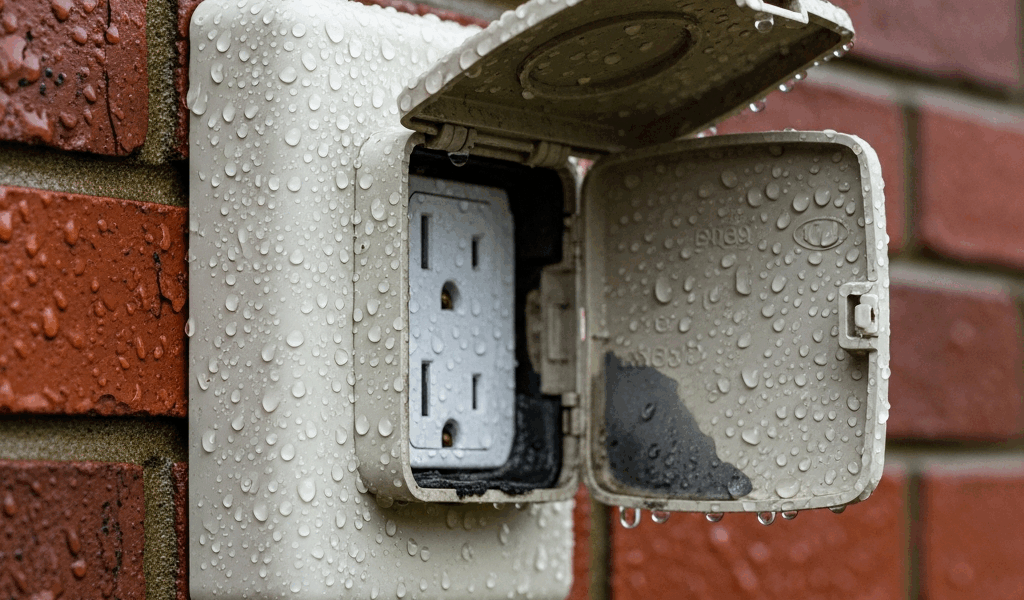
Quick answer: If an outdoor outlet or GFCI stopped working after rain, keep people and equipment away from the wet area and do not open the box, remove a cover, touch wet devices, or repeatedly reset the protection. From a dry, safe location, unplug connected equipment only if that can be done without approaching water. If there is visible water, flooding, heat, odor, damage, buzzing, arcing or repeated tripping, leave the circuit off and call a qualified electrician.
If the receptacle and surrounding area are dry, undamaged and not submerged, the homeowner-level checks are limited: identify the protecting GFCI, follow its manufacturer’s TEST/RESET instructions once, and check the labeled breaker from a dry panel location. A GFCI that will not reset may be correctly blocking power because a fault remains, may have no upstream power, or may have failed.
Rain-related outdoor outlet decision table
| What you observe | Safest next step |
|---|---|
| Standing water, floodwater or a submerged device | Do not touch it; isolate power through the safe/authorized process and have affected equipment evaluated or replaced |
| Water visible inside the enclosure, cracked cover, scorch, heat, odor or buzzing | Keep the circuit off and call a qualified electrician |
| Dry, intact receptacle; GFCI is visibly tripped | Remove loads from a dry position and follow the device’s labeled reset instructions once |
| GFCI will not reset | Stop; the device may lack power, detect a continuing fault, be miswired or have failed |
| Reset holds with no load but trips when one item is connected | Disconnect and stop using that equipment; have the equipment/circuit evaluated |
| Reset trips again with all accessible loads disconnected | Leave it off and call a qualified electrician |
Why rain can trip GFCI protection
A ground-fault circuit interrupter compares current on the conductors and quickly interrupts power when it detects an imbalance consistent with current taking an unintended path. Moisture can create or expose such a path in a receptacle, plug, cord, connected appliance, junction, damaged cable or another downstream part of the protected circuit.
The trip is a safety response, not proof that the GFCI is defective. Resetting without correcting the moisture entry or damaged equipment can restore a hazardous condition or simply cause another trip.
First: decide whether this is a flood/submersion event
Rain exposure at an outdoor cover is not the same as electrical equipment that has been under water. The U.S. Consumer Product Safety Commission warns that circuit breakers and GFCIs that have been submerged must be replaced because water and silt can prevent them from performing properly; apparent operation after drying is not proof of safety.
If water rose to the outlet, panel, breaker, GFCI, extension connection or equipment:
- do not enter standing water to reach a switch, plug or panel;
- do not attempt to test or reset submerged equipment;
- use emergency/utility/qualified electrical assistance appropriate to the situation;
- do not reenergize affected equipment until it has been evaluated and replaced as required.
Find the GFCI that protects the outdoor receptacle
The dead outdoor receptacle may have TEST and RESET buttons, but it can also be downstream from another GFCI receptacle or a GFCI circuit breaker. The protecting device may be in a garage, basement, utility area, bathroom or another exterior location depending on the installation.
Use labels, as-built information and accessible device faces; do not remove covers or open boxes to trace wiring. A standard-looking downstream receptacle can still be GFCI protected upstream. If protection cannot be identified, an electrician can test and map the circuit.
Safe reset sequence for a dry, undamaged installation
- Wait until the receptacle, cover, plugs and surrounding surface are visibly dry. Do not use a heater, open flame or improvised drying method on the box.
- From a dry position, disconnect accessible connected equipment. Do not handle a wet plug or cord.
- Inspect only what is visible without opening the enclosure: cracked or missing cover, broken face, discoloration, water tracks, loose device, heat or odor.
- If no hazard is visible, follow the exact TEST/RESET instructions printed on or supplied with the GFCI.
- If it will not reset, stop. Check whether the labeled breaker has tripped only if the panel location is dry, accessible and undamaged.
- Reset a breaker at most once following its label/manufacturer procedure. If it trips again or will not remain set, leave it off.
A manufacturer such as Leviton notes that a GFCI may refuse to reset when there is no incoming power, a ground fault remains, line/load wiring is incorrect, or the device is damaged. Reset lockout is a safety feature; forcing or repeatedly pressing the button is not a repair.
Do not test a suspect wet outlet with an appliance
The old version of this guide recommended plugging in a lamp, radio or phone charger after a wet trip. That is not an appropriate first proof of safety. A connected load can energize damaged or wet parts, and a small load does not verify enclosure integrity, grounding, GFCI performance or downstream wiring.
Use the GFCI’s labeled TEST function only when the device is dry and safe to approach, then follow the manufacturer’s expected result. CPSC notes that GFCIs should be tested regularly because a device can potentially supply power without providing proper shock protection. If the TEST/RESET behavior does not match the instructions, stop using the receptacle.
Inspect the weather protection without opening the box
From the exterior, look for a missing/broken cover, cracked housing, cover that cannot close around a connected cord, gaps caused by damage, or evidence that runoff is directed at the enclosure. Do not remove the faceplate, loosen the receptacle, probe the box or touch internal wiring.
Current electrical requirements distinguish damp and wet locations and the conditions under which a cover must remain weatherproof. Outdoor receptacles commonly require listed weather-resistant receptacles and appropriate weatherproof enclosures; wet-location installations may require protection while a plug is inserted. The adopted code edition, local amendments, product listing and installation instructions govern the specific property.
A deep “in-use” cover is not universally sufficient by itself. The cover must be listed and correctly configured for the device, orientation, box and cord use, and the entire assembly must be installed to prevent moisture entry as required.
Common causes an electrician may investigate
- failed or moisture-damaged GFCI/receptacle;
- damaged or incorrectly installed wet-location cover/enclosure;
- water entry behind the box or through conduit/cable paths;
- faulted outdoor lighting, holiday decorations, pump, tool, cord or appliance;
- damaged downstream receptacle or junction on the same protected circuit;
- line/load or other wiring error from prior work;
- open connection or tripped breaker upstream;
- deteriorated insulation, corrosion or pest damage.
Do not assume the cheapest visible component is the cause. The correct repair depends on test results and the listed installation.
When to stop immediately
Leave the circuit off and obtain qualified help when:
- water is inside the cover/box or equipment was submerged;
- the receptacle, cover, plug, cord or panel is hot, buzzing, arcing, cracked, discolored or smells burned;
- the GFCI or breaker trips again after one controlled reset with accessible loads disconnected;
- the GFCI cannot complete its labeled test/reset sequence;
- a wet cord or plug cannot be disconnected without approaching the hazard;
- multiple circuits or part of the home are affected;
- you cannot identify the protecting device or safely isolate the circuit.
Call emergency services for smoke, fire, active arcing or immediate shock/fire danger. Do not use water on energized electrical equipment.
Prevent another rain-related trip
- Have damaged receptacles, gaskets, boxes and listed covers replaced with components suitable for the location and use.
- Keep unused covers closed and follow the cover instructions when a cord is connected.
- Use outdoor-rated cords/equipment and keep plug connections out of standing water.
- Do not route cords through doors/windows where they can be damaged.
- Use the GFCI TEST function at the interval stated by the manufacturer and replace a device that fails its test.
- Correct roof, gutter, siding, drainage or irrigation conditions directing water at electrical equipment through the appropriate trade.
Do not caulk blindly around an electrical box. Incorrect sealing can trap water or violate the product/assembly instructions. A qualified installer should identify the water path and use materials/details compatible with the enclosure and wall system.
Frequently asked questions
Should I keep pressing RESET until it stays?
No. One controlled reset after the area is dry and hazards are absent is enough. A device that refuses or trips again is signaling a remaining fault, missing power, damage or failure.
Can I remove the cover to let the outlet dry?
No. Removing a cover can expose energized or damaged parts and further compromise weather protection. Keep the circuit isolated and have the assembly evaluated.
Will a bigger weatherproof cover fix it?
Not automatically. The receptacle, box, cover, mounting, orientation, cord use and water path must form a listed installation suitable for the location.
Is a dead outdoor receptacle always on its own GFCI?
No. It may be protected by an upstream GFCI receptacle or breaker. Use labels and safe visible checks; do not open boxes to trace it.
Can submerged GFCI equipment be dried and reused?
CPSC says GFCIs and breakers that have been under water must be replaced because contamination can keep the safety device from operating properly.
Authoritative references
- U.S. CPSC: GFCI Fact Sheet
- U.S. CPSC: Home Electrical Safety Checklist—Outdoor Outlets
- U.S. CPSC: Replace GFCIs and breakers that were under water
- NFPA 70 code-development record: receptacles in damp and wet locations
- Leviton: GFCI reset-lockout causes and response
Electrical-safety and product sources were checked in August 2026. The locally adopted code, authority having jurisdiction, product instructions and qualified site evaluation control the actual installation.




Stay in the loop
Get the latest northwest electric pros updates delivered to your inbox.