“`html
What the NEC Says About Ceiling Fan Support
I’ve installed more ceiling fans than I care to count, and here’s the biggest mistake I see—from DIYers and even some contractors who should know better—treating ceiling fan installation like it’s the same as hanging a light fixture. It’s not. The National Electrical Code has specific requirements for ceiling fan support, and honestly, most people don’t know them.
The governing standard is NEC Article 422.18, which addresses support of ceiling-suspended equipment. Here’s what it actually says: “A ceiling-suspended (including pendant) luminaire [or fan] shall be supported independently of the outlet box.” But there’s a critical caveat tucked in there. If the outlet box is specifically listed and labeled for fan support—and the fan weight doesn’t exceed the box’s rated load—then the box can serve as the sole support.
The distinction matters enormously. “Adequate support” in code language means two things: First, the box itself must be rated for the fan’s weight. Second, the framing and fastening behind that box must be capable of holding that load. A standard old-work box rated for 50 lbs on the label might actually fail under NEC 422.18 if the framing it’s attached to is compromised, splintered, or sitting in a joist that’s been undersized for decades.
I learned this the hard way. Probably should have opened with this section, honestly. Five years ago, I installed a fan in a 1978 home with what looked like solid ceiling. The box was rated 60 lbs; the fan weighed 34 lbs. Seemed fine. Two months later, the homeowner called—the fan was swaying. I went back and found the joist supporting the box had a hidden crack, likely from wood movement over 40+ years. The box rating didn’t account for structural degradation.
Here’s the key distinction: boxes rated for fans versus boxes rated for lights only. A light-duty box—typically marked for “fixture support only”—is usually rated between 25 and 50 lbs and assumes minimal vibration. A fan-rated box must handle rotational forces and gets tested to higher standards. Look for the label. If it says “ceiling fan approved” or “fan-rated,” you’re in compliance territory. If it just says “fixture support,” you’re in trouble.
How to Check Your Ceiling Box Load Rating
Start by identifying what’s actually in your ceiling. Turn off power at the breaker, remove the fan (or the light fixture currently there), and inspect the box. You need three pieces of information: box type, load rating, and current fan weight.
Old-work plastic boxes are common in homes built 1970–2000. These have ears that grip from below the drywall. Flip the box forward and look for any label or stamping. The rating should be visible—usually 50 lbs maximum for standard models. Old-work metal boxes (similar era) often have higher ratings because metal is stiffer; these typically range 50–75 lbs depending on gauge and fastening method.
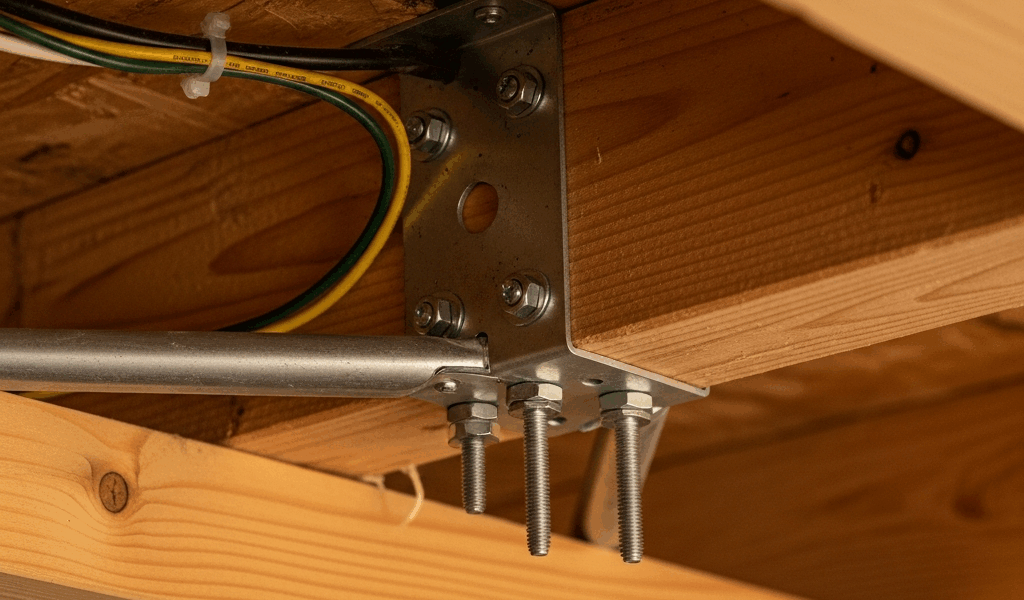
New-work bar braces—the adjustable metal bars that span between two joists—are the gold standard for fan support. These are specifically designed for fans and come pre-labeled with load ratings, usually 75–125 lbs for residential models. The model number and rating should be stamped on the bar itself.
Here’s what you’ll actually encounter:
| Box Type | Typical Rating | Fan-Rated? | Common Era |
|---|---|---|---|
| Old-work plastic (standard) | 50 lbs | No | 1970–2005 |
| Old-work metal (heavy gauge) | 75 lbs | Maybe | 1960–1990 |
| Shallow pancake box | 25 lbs | No | 1950–1980 |
| New-work fan bar brace | 75–125 lbs | Yes | 2000–Present |
Now find your fan’s weight. Check the UL label on the fan motor housing (usually on the back) or consult the installation manual—look for “net weight” or “unit weight,” not shipping weight. Most residential fans range 25–55 lbs, but larger models (60-inch blade spans or heavier construction) can hit 70+ lbs.
If you can’t find the rating—maybe the box is from 1975 and has no label, or the label is illegible—assume it’s undersized. Don’t guess. At that point, you’re looking at a replacement or reinforcement.
When Your Box Won’t Support the Fan
This is where compliance becomes action. If your box is rated for 50 lbs and your fan weighs 45 lbs, you’re technically within spec. But if the framing is questionable, or if the box is older and the fastening has loosened, you’re out of compliance.
Three solutions exist. First: install a reinforced fan-rated bar brace. This is the right answer 80% of the time. You’ll remove the old box, cut a hole in the drywall between two joists, fit the adjustable brace—models like the Caddy FastBrace or Arlington FanBrace run $30–$60—and attach a new fan-rated box to it. Total time: 45 minutes if the joists are accessible from an attic or crawlspace. Cost is roughly $50–$100 in materials plus labor. This fully satisfies NEC 422.18 because the support is now independent of the box itself — the brace bolts directly to the joists.
Second: add sister joists if framing is compromised. If the joist under your current box is cracked, split, or has visible rot—especially common in Pacific Northwest older homes—sistering restores structural integrity. Bolt a new piece of lumber alongside the damaged one. This requires access to the joist (attic crawl) and usually 2×8 lumber alongside a 2×10, lag bolted every 12 inches. This is more involved and typically warrants a structural assessment, but it’s the right fix for genuine framing failure.
Third: relocate the fan. Sometimes the simplest solution is to move the fan to a joist that can actually support it. If your current location is above a beam or in a weakened section of framing, moving 3 feet over to solid framing avoids all the reinforcement work. Run new electrical cable in the attic and install a new box on solid wood.
Why does this matter from code? NEC 422.18 isn’t a “nice to have.” It’s a minimum safety requirement tied to building permits and homeowner insurance. A fan installation that doesn’t meet code is technically non-compliant, even if it stays up for 10 years. If something goes wrong—the fan crashes, someone gets hurt, or an insurer denies a claim—you’re liable.
Hard truth: if you’re retrofitting a fan into a pre-1975 home, the existing box almost certainly doesn’t meet current code, regardless of whether it’s physically holding the fan. Building codes have evolved. Older homes were built to older standards. That 50-year-old installation may have held fine, but it doesn’t align with what NEC requires today.
PNW Climate Consideration — Ice Dam Load
This is where my region-specific angle applies. The Pacific Northwest isn’t just about rain; it’s about snow load and ice accumulation on roofs. Standard fan weight specs—that 34 lbs printed on the label—assume a controlled indoor environment with no external load.
In older PNW homes, especially those with poor attic ventilation, moisture and temperature cycling degrade framing over decades. An attic that stays perpetually damp (common in our climate) sees wood shrinkage and movement. A box rated for 50 lbs when the home was built in 1972 may be effectively undersized now, not because the rating changed, but because the surrounding framing has weakened.
Additionally, building code snow loads in the Pacific Northwest vary by zone. Coastal areas near sea level assume lighter loads; mountain zones assume 40–100+ psf (pounds per square foot) of roof load. Your ceiling joists were sized for these loads plus live load. A ceiling fan bracket that’s only rated for the fan’s static weight doesn’t account for the dynamic environment of a PNW roof system. This is why I emphasize checking framing integrity, not just box ratings, in our region.
Signs Your Ceiling Fan Installation Is at Risk
Watch for these warning signs. Sagging drywall around the ceiling box usually means the framing is deflecting under load—either the fan weight is beyond what the joists can handle, or the joists themselves are compromised. This isn’t cosmetic; it’s structural.
Cracking around the box perimeter often indicates movement—either the box fasteners are loose, or the framing is shifting. Small cracks (hairline) might just be drywall settling, but wide cracks (1/8 inch or more) suggest the box is moving relative to the surrounding drywall.
Fan wobbling despite correct installation is a red flag. If the motor is balanced but the fan still sways on high speed, the mounting bracket is flexing. This usually means the box or the framing behind it isn’t stiff enough for the rotational load.
Water stains around the box signal framing compromise—wet wood loses strength. If you see water damage, the joist is likely softer than it was when rated.
Visible movement when the fan is running at high speed is unacceptable. The fan should be rock-solid regardless of speed. Any visible deflection of the drywall or box means the support isn’t adequate per code.
If you spot any of these, stop using the fan and call an electrician. This isn’t DIY-fixable at that point. You need a professional assessment of framing integrity before you can safely proceed.
“`


Stay in the loop
Get the latest northwest electric pros updates delivered to your inbox.