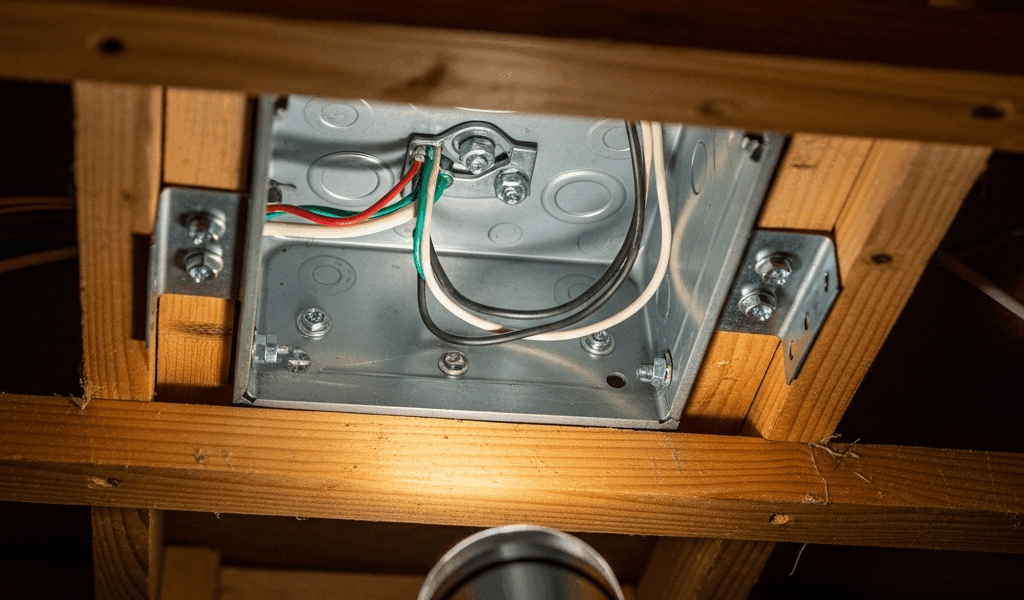
Quick answer: Do not decide that a light-fixture box can support a ceiling fan from its shape, depth, color or material. Verify either an explicit fan-support listing/marking on the box or box system, or an approved independent connection to structural framing. Then confirm the actual fan is within the marked fan rating and that every component is installed according to its instructions.
If you cannot verify the support without opening an electrical box, use a qualified electrician. Switching a light off does not necessarily de-energize every conductor in a ceiling box, and a visual glance cannot prove hidden brace or fastener installation.
The three checks that decide whether the location is fan-ready
- Product identification: find the box or brace manufacturer, model and fan-support marking.
- Support path: verify the listed box system or the fan bracket’s approved structural connection is installed as designed.
- Installed fan: confirm the fan’s weight, mounting hardware and ceiling configuration fit those instructions.
All three must pass. A fan-rated box installed incorrectly is not a safe system. A solid-looking brace with an unverified rating is not evidence. A lightweight fan does not make an ordinary light box acceptable as its sole support.
1. Look for an explicit fan-support marking
NEC 314.27(C) requires an outlet box or outlet-box system used as the sole support of a ceiling-suspended fan to be listed and marked by its manufacturer as suitable for that purpose. Useful wording may include “suitable for fan support,” “ceiling fan rated,” or a product-specific fan weight.
The exact marking varies by manufacturer and model. Photograph every visible label, stamped number and molded identifier, then compare it with the manufacturer’s current data sheet and instructions. Do not rely on a marketplace listing or a similar-looking product photo.
A rating printed for a fixture or luminaire is not automatically the fan rating. Manufacturers often publish different limits because a rotating fan creates different loading. Hubbell/RACO, for example, lists separate fan and fixture ratings on several products.
2. Do not infer the answer from box material
“Metal means fan-ready” and “plastic can never support a fan” are both incorrect shortcuts. A generic metal fixture box may not be listed for fan support. A specifically designed nonmetallic box can be UL listed and fan-rated when installed as directed.
Hubbell/RACO’s 7120-1 Saddle-Box is one published example: it is a polycarbonate product identified as ceiling-fan rated, UL listed and rated for a 70-pound fan. That example does not validate another plastic box; it demonstrates why the exact model and listing control.
3. Identify the support system—not merely the visible box
Common approved designs include:
- a listed fan box fastened to a ceiling joist under its instructions;
- a listed fan brace-and-box system spanning framing members;
- a listed saddle or pan system installed in its specified framing configuration; or
- an outlet arrangement that provides access for the fan bracket to be supported independently by suitable structural framing.
Old-work and new-work describe when/how a product is installed; they do not by themselves establish a weight rating. RACO publishes both old-work and new-work fan-support solutions. Likewise, “brace bar” is not enough: the exact brace-and-box assembly must be identified and installed within its span, fastener and fan-weight conditions.
One current RACO Retro-Brace example illustrates why model instructions matter: the published rating differs with joist spacing. A generic statement that every brace holds 70 pounds would be wrong.
What you can verify without disturbing wiring
Start with records and accessible documentation:
- the fan installation manual and model specification;
- photos or invoices from the original installation;
- permit and inspection records, when applicable;
- an accessible attic view that does not require touching wiring or components;
- a visible box/brace label or model number; and
- the manufacturer’s instructions for that exact model.
These sources may establish what was intended, but installation still must match the instructions. A purchase receipt for a rated brace does not prove it was fastened or expanded correctly.
When the canopy must be opened
Opening a canopy or ceiling box exposes electrical and mechanical components. The circuit must be de-energized at the correct breaker and absence of voltage verified with suitable test equipment by someone qualified. Do not rely on a wall switch, a remote control or the fan being stationary.
An inspection may need to confirm:
- the fan-support marking inside the box;
- the model and fasteners used;
- whether the fan bracket connects to the listed box or structural framing as intended;
- signs of deformation, looseness, corrosion or damaged conductors;
- grounding and bonding;
- box fill and conductor condition; and
- compatibility with a sloped-ceiling adapter, downrod or other accessory.
Do not pull downward on the box, hang body weight from it or shake the installed fan to “test” capacity. A field force test is not part of the listing and can damage a marginal installation without revealing hidden defects.
How the fan’s weight affects the answer
Use the fan manufacturer’s installed-weight specification for the selected configuration. Do not use shipping weight. If a light kit or accessory changes the applicable supported weight, follow the product instructions.
The frequently cited 35- and 70-pound figures do not replace the marked rating. For the rule and examples, see the ceiling fan box weight-limit and NEC guide.
A box system marked for a 35-pound fan must not be treated as 70-pound rated. A luminaire rating of 150 or 210 pounds does not permit a fan of that weight. Read the fan line.
Red flags that mean stop
- no fan-support marking or identifiable structural support;
- a label that expressly excludes fan support;
- the fan exceeds the marked fan rating;
- missing, substituted or improvised mounting hardware;
- the box, brace, canopy or mounting point moves relative to the ceiling;
- cracks, deformation, corrosion, damaged insulation or loose conductors;
- burning odor, arcing, smoke or heat discoloration; or
- installation instructions that do not match the framing or ceiling type.
If a fan has fallen or exposed wiring is present, the CPSC advises turning off the circuit breaker because of the electrical hazard. Keep people away from the area and obtain qualified assistance.
When a retrofit is the right answer
If the support cannot be identified or does not qualify, use a listed fan-support solution suited to the actual framing and ceiling. Manufacturers offer direct-to-joist boxes, saddle boxes, braces for accessible new work, and retrofit braces installed through an existing opening.
Do not select solely by advertised capacity. Check:
- old-work versus new-work application;
- joist spacing and orientation;
- ceiling thickness and material;
- fan and luminaire ratings separately;
- box volume and wiring method;
- dry, damp or wet-location suitability;
- the supplied mounting hardware; and
- local permit and inspection requirements.
A retrofit can sometimes be completed through the existing opening, but that does not make it a universal beginner project. Damaged wiring, aluminum conductors, inaccessible framing, unusual ceilings and uncertain circuits require professional evaluation.
Questions to ask an electrician
- What exact box or support-system model is installed?
- Where is its fan-support listing and marked maximum?
- Is the fan supported by the box system or independently by framing?
- Does the installation match the manufacturer’s required fasteners and span?
- Is the fan within the marked fan rating in its installed configuration?
- Does the locally adopted code require a permit or inspection for the change?
Document the answer with photos and product instructions for future maintenance.
Frequently asked questions
Does a box that feels solid support a fan?
Not necessarily. Rigidity by hand does not prove the product listing, marked capacity, hidden support or correct installation.
Can I tell from the screw size?
No. Fan-support products often use specific hardware, but screw size alone does not establish the complete system’s listing or installation.
Is a box attached to a joist automatically fan-rated?
No. Direct framing can be part of an approved design, but the box, fan bracket, fasteners and manufacturer instructions still determine how the fan is supported.
Can an old-work box support a fan?
A generic drywall-clamping fixture box cannot be assumed suitable. Listed old-work fan brace-and-box systems exist and must be installed within their stated conditions.
Should I assume an unmarked box supports 35 pounds?
No. The 35-pound NEC language concerns marking requirements for listed fan-support systems designed above that weight; it does not grant unmarked boxes a default fan rating.
Authoritative references
- Leviton Captain Code: NEC 314.27(C) fan-support requirements
- Hubbell/RACO: choosing the correct ceiling-fan box
- Hubbell/RACO: ceiling-fan box FAQ and certification guidance
- Hubbell/RACO: listed nonmetallic fan-box example
- Hubbell/RACO: retrofit brace ratings and installation conditions
- CPSC: ceiling-fan fall and exposed-wiring safety notice



Stay in the loop
Get the latest northwest electric pros updates delivered to your inbox.