“`html
How to Know If Your Ceiling Can Hold That Fan
Standing in my attic at 10 PM on a Saturday, box in hand, I learned about ceiling fan weight limits the hard way—realized immediately the thing wouldn’t fit the existing hole. But that discovery? Not even close to the real problem most homeowners face when they decide to upgrade their lighting. The actual issue: you can’t just bolt any fan to any ceiling and call it a day.
Two things fail when they fail. The electrical box itself—that metal housing bolted to your drywall. And the framing behind it, the wooden joist running through your ceiling. A standard old-work ceiling box, the kind already sitting in most homes, carries a UL rating of 35 pounds maximum. That’s everything combined: fan, light kit, canopy hardware, the whole assembly. Retrofit boxes bump that to 50 pounds. Your joist, though—that wooden beam holding everything up—has its own weight limits nobody mentions until something goes wrong.
Before you buy that fan, you need to run this diagnostic.
Step one: identify your existing box. Access your attic if you can, climb up, look at whatever’s holding your current ceiling fixture. Old work boxes—installed from below with fold-down brackets—usually have a label or stamp showing their rating. See nothing stamped on there? Assume 35 pounds. See “reinforced,” “heavy-duty,” or a brace bar running perpendicular to your joists? You’re probably looking at 50+ pounds capacity. Snap a photo with your phone. You’ll need this number in a minute.
Step two: check your joist spacing and what they’re made of. Standard 2×6 joists spaced 16 inches apart (center to center) can handle roughly 50 pounds in the middle of the span. Drop to 2×4 joists and you’ve cut that capacity in half. Space them 24 inches apart instead of 16? Divide again. I’ve seen homes from the 1970s—2×4 joists, 24-inch spacing. Those ceilings topped out around 20 pounds. Your 60-pound fan, installed off-center away from the joist? The load concentrates and suddenly you’ve got a real problem.
Step three: find what your specific fan actually weighs. Grab the product manual or the box itself. Not the marketing website—the manual. It’ll say something like “Shipping weight 45 lbs” or “Fixture weight 28 lbs.” The fixture weight is what matters here. Then add 10–15 pounds if you’re installing a light kit, plus the canopy hardware. A typical 52-inch pull-chain fan runs 25–30 pounds. That wrought-iron chandelier-style fan you’re eyeing? Can hit 70 pounds easy.
Now compare. Your fan weighs 55 pounds but your box is rated for 35? You need a new box. Box is rated for 50 but your joists are 2×4 on 24-inch spacing? You still need reinforcement—just at the framing level instead.
The Upgrade Path When Your Ceiling Isn’t Ready
You’ve done the math. Your ceiling can’t handle what you want to install. Three options exist, ranked by difficulty and what you’ll spend.
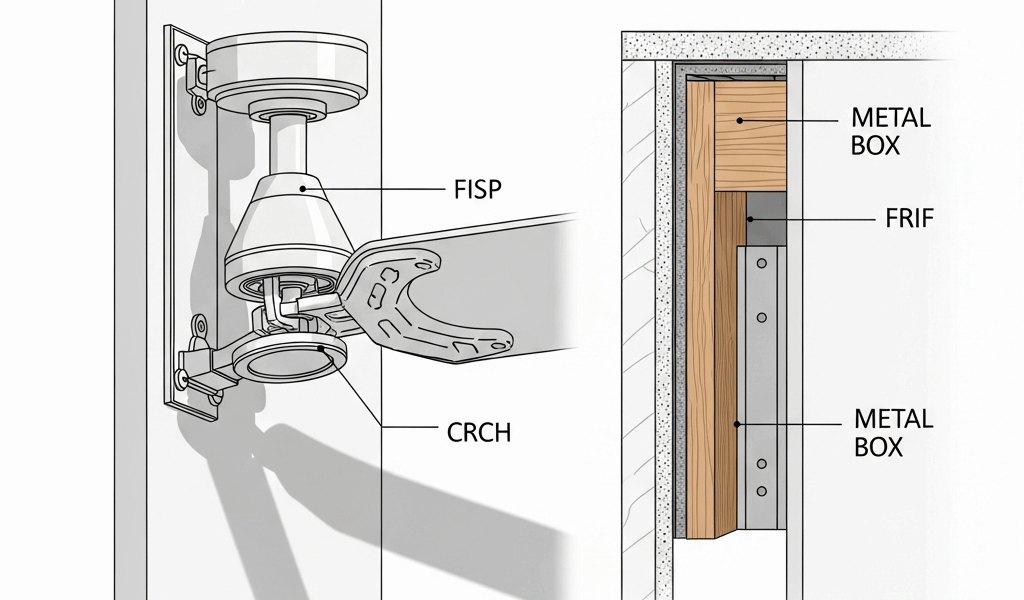
Option one: replace the ceiling box with a heavy-duty brace. Most common fix by far. A UL-listed fan brace—Arlington, Raco, Hubbell make them—costs $20 to $40 and bolts straight into your existing joist. The brace sits perpendicular to the joist, grips it with bolts on both sides, and your new electrical box attaches to the brace. Load spreads across a wider joist area, and the new box is usually rated 50+ pounds.
You’ll need a drill with a 1/2-inch bit, a wrench or socket set, drywall saw, and maybe 30 minutes in the attic. Remove the old box (or leave it, cap it with a blank cover), bolt the brace through the joist, slide it into place, secure the new box to it. Probably should have opened with this section, honestly. It works, it’s code-compliant, and it’s cheap.
Option two: retrofit bracket bolted to the joist. No attic access? Apartment with a dropped ceiling, or blown-in insulation you’d rather not disturb? Retrofit heavy-duty brackets bolt through drywall directly into the joist from below. More invasive approach. The bracket hangs from the joist, electrical box clips to the bracket, you patch drywall around it. Visible from below, requires more cutting. Cost runs $35–60 for the bracket itself, and installation takes longer because you’re working blind, drilling through drywall from below.
Call a professional for this one. The drilling angle matters—miss the joist and you’ve got a ceiling bracket held up by drywall alone. That defeats the entire purpose.
Option three: reinforce the joist itself. Doesn’t happen often, but it happens. You’re in an older home with 2×4 joists on 24-inch spacing and your 50-pound fan has nowhere safe to go. You sister another joist (bolt a matching 2×6 or 2×8 alongside the existing one) or install blocking to share the load. Needs carpentry skill and probably a professional. Cost ranges $300 to $600+ depending on scope and whether you need structural assessment. This is when you sit down and ask yourself: do I really need this specific fan, or would a 35-pound model work fine?
NEC Requirements That Actually Matter Here
Article 422.18 of the National Electrical Code: ceiling fan mounting boxes must be listed and labeled for the specific load they’ll carry. Not “somewhere around” that load. Not “probably.” Listed. Labeled. Certified. Tested. Rated.
Why does that matter? Because when a 60-pound chandelier-style fan falls on someone’s head, the liability is yours—not the manufacturer’s, not the inspector’s. The inspector approves your installation based on the box rating at inspection time. Box is undersized for the load? You failed the code requirement. You’re the one explaining it to an insurance adjuster.
UL 1598 covers ceiling fans themselves—electrical safety, mechanical strength, stability, thermal performance. Doesn’t mandate the installation infrastructure though. That’s where NEC 422.18 comes in. The code assumes you’ll use an appropriate box for the weight you’re hanging.
Real example: a $15 standard ceiling box rated for 35 pounds cannot legally support a 60-pound ornate fan. A $35 reinforced box can. Inspector catches the mismatch during rough-in, they fail you. Even if they don’t show up, you’re not code-compliant. Matters when you sell the house. Matters when you file an insurance claim.
Weight Ratings You Can Actually Trust
Manufacturers list weight specs in three places. Only one is reliable.
The product website lists “shipping weight”—that includes packaging and padding. Ignore it. The product manual has fixture weight, usually accurate because retailers need that for logistics. The product box itself, printed on the side or back, typically lists the actual weight of the fan and motor assembly alone.
A typical 52-inch pull-chain fan—basic model at any big-box store—weighs 25–30 pounds. Add a standard light kit and you’re at 35–40 pounds. Heavy wrought-iron canopy and decorative hardware? You’re pushing 50 pounds or more. Flushmount fan (installed directly to the ceiling, no rod) weighs less because there’s less metal involved. Ceiling fan with an integrated chandelier easily exceeds 70 pounds.
Where people go wrong: they see “lightweight” in the marketing copy and assume 20 pounds. Then they open the box and the fixture assembly is heavier than expected. Or they buy a light kit separately, never realizing the total load will exceed their box rating.
Do this instead: read the manual PDF before you buy. Search the model number plus “weight” or “specifications.” Call the manufacturer if specs aren’t clear. Spend two minutes confirming the total load, including any accessories you’re adding. Not paranoia. This is the difference between an installation holding for 20 years and one that fails in year two.
When to Call an Electrician vs. DIY
Not every homeowner should tackle a ceiling box swap. Here’s where the line sits.
DIY territory: Full attic access, unobstructed views of the target joist, installing a heavy-duty brace with a new box rated for your fan’s weight. The box is easy to remove, the new brace bolts in straightforward, you have basic tool skills. Time: 45 minutes to an hour. Materials: $30–40. Low-risk, saves you money.
Call a pro: No attic access and you need a retrofit bracket bolted from below. Reinforcing an undersized joist. Installing in old plaster ceilings—those are fragile, can collapse if you drill wrong. Your existing box is inaccessible or damaged. You’re uncomfortable with electrical work or tool use. Professional electrician charges $150–300 for straightforward box swap, $300–600+ for joist reinforcement or retrofit work. That’s the cost of knowing it’s done right and not waking up to a fan hanging by drywall anchors.
I’m apparently more comfortable with electrical work than structural stuff. If the diagnostic tells me the joist needs reinforcement, I call a carpenter. Not worth guessing on that one.
The stakes are real: your safety, liability if someone gets hurt, and code compliance if you sell or have the work inspected. Spend the $40 on the right box, or spend the $300 on professional installation. Both cost less than the lawsuit.
“`




Stay in the loop
Get the latest northwest electric pros updates delivered to your inbox.