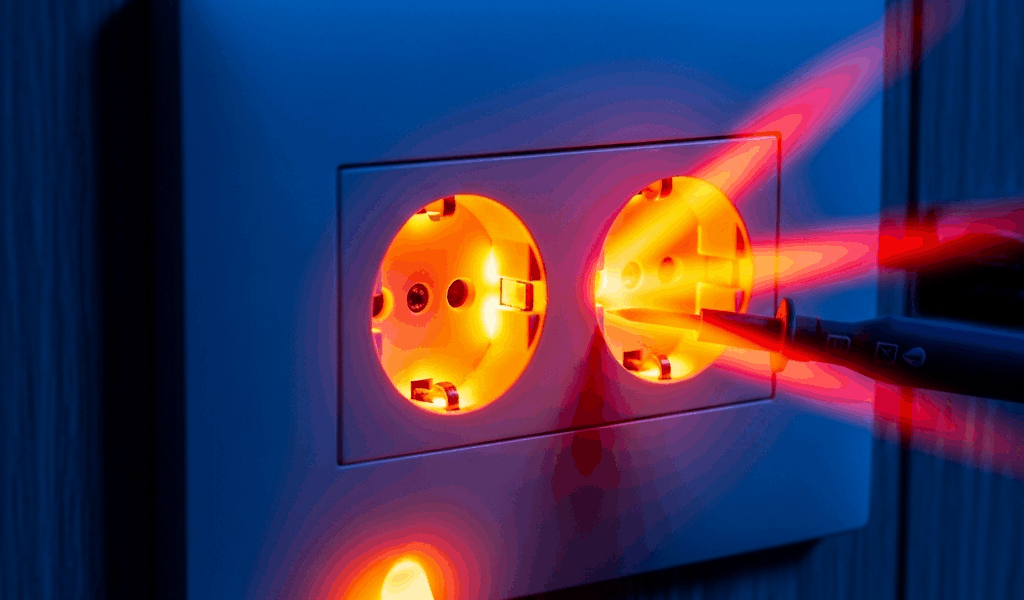
Why a Hot Outlet Is a Different Problem Than a Dead One
Hot outlets have gotten less clear-cut with all the conflicting advice flying around online.
Three years ago, my kitchen outlet felt warm to the touch. Scary warm. But my phone charger worked fine when I plugged it in. So I ignored it for two weeks.
Big mistake.
But what is a hot-but-working outlet? In essence, it’s an outlet delivering normal voltage while simultaneously generating dangerous heat somewhere in its connections. But it’s much more than that — it’s a warning sign most homeowners completely miss because the thing still works.
Most people assume outlets either work or they don’t. Heat at a functioning outlet sits in this weird middle ground nobody talks about. Dead outlets are one thing. A hot outlet with full voltage is something else entirely. Resistance is building somewhere. That’s the real problem.
Here’s the distinction that actually matters: slight warmth during heavy use — say, a space heater pulling 12 amps — can be normal. The plate might feel barely warm, like a laptop bottom after an hour. Not ideal, but not a fire risk either.
An outlet hot enough that you pull your hand back? Never normal. Heat means resistance, and resistance generates more heat. Vicious loop. That’s how fires start inside walls where nobody can see them.
The confusing part is that everything still seems fine. Your devices charge. Your lamp turns on. Until your wall smells like burnt plastic at 2 a.m. — and by then, you’re already in trouble.
First Check — Eliminate the Easy Causes
Before assuming your wiring is failing, rule out the boring stuff. These checks take five minutes. Might save you a $200 electrician call. Probably will, actually.
What’s actually plugged in?
High-draw appliances generate heat in outlets. A 1500-watt space heater or a hair dryer pulling 12 amps will warm things up — that’s just physics, not a fault. Unplug everything and wait 15 minutes. Outlet cools back to room temperature? You’ve found your culprit. You can keep using it, but don’t daisy-chain a power strip into that outlet or pile more devices onto the same circuit.
Are you daisy-chaining power strips?
One power strip in an outlet is fine. Two strips, one plugged into the other? That’s how you load a circuit past its limit and turn an outlet into a heating element. Spread high-draw devices across different circuits. Don’t repeat what I did — I had a space heater, a coffee maker, and a power strip all sharing one tired 15-amp circuit in my kitchen.
Is the outlet near a heat source?
Baseboard heaters, radiators, and floor vents can warm an outlet from outside the wall entirely. Annoying, but not dangerous. Move your thermometer. If the outlet sits suspiciously close to a heat source, that’s a code issue — but it’s not urgent unless you’re smelling something off.
If none of those apply — if the outlet is hot with nothing plugged in, or stays hot after you’ve unplugged everything — move to the next section.
How to Check for a Loose or Failing Connection
Frustrated by the discovery that my outlet problem was actually a loose wire the whole time, I grabbed a Klein Tools non-contact voltage tester for $8 at my local hardware store and learned how to look inside without electrocuting myself.
Here’s what you need:
- A non-contact voltage tester — around $8 at any hardware store; I use the Klein Tools model and it’s been reliable for three years straight
- A flathead screwdriver
- Your phone’s flashlight
- Your breaker panel labels
Turn off power at the breaker. Not a wall switch — the actual breaker. Find the right one using your panel labels. If they’re unlabeled (mine weren’t labeled at all when I bought the house), flip breakers one at a time while someone tests the outlet with a lamp.
Test with your non-contact tester even after killing the breaker. Should show zero voltage. If it still shows voltage — stop immediately. There’s a wiring problem beyond basic troubleshooting, and you need an electrician.
Assuming it’s dead, unscrew the outlet plate, then carefully unscrew the outlet itself from the electrical box. Pull slowly. The wires are still attached back there.
Now look at the connections. Most outlets have two types: screw terminals on the sides and backstab holes in the back. Backstab connections are the villain here — I’m apparently not the only one who got burned by them, and switching to screw terminals works for me while backstab connections never held up long-term.
Backstab wiring looks convenient. Just push the wire in, it grips, done. But over time — especially with high-amperage devices — those push-in terminals lose their grip. The wire slides out slightly. Resistance builds. Heat follows. That’s the whole ugly story.
Look for discoloration, black scorch marks, or a wire that visibly isn’t fully seated. Any of that means the outlet is shot and needs replacing. Connections look clean and tight? The outlet probably isn’t your problem — look upstream.
Worth mentioning before anything else. Even a good outlet using backstab connections isn’t ideal on high-load circuits. If you’re already replacing it, use screw terminals instead. Wrap the wire around the screw before tightening. That creates a mechanical bond that holds for decades, not months.
When the Breaker and Wiring Are the Real Problem
Sometimes the outlet is completely fine. The problem lives upstream.
Check what else shares that circuit. Pull up your breaker panel label. If that single 15-amp breaker is feeding your kitchen outlet, your microwave, and your refrigerator simultaneously, you’re overloaded before you even plug in a hair dryer. Something will heat up trying to push more current than the circuit was ever designed to handle.
The breaker should trip before heat becomes serious. If it isn’t tripping, the breaker itself might be failing. A breaker that won’t trip is an immediate fire hazard — that part isn’t optional to fix.
Here’s a regional concern worth calling out separately. Older Northwest homes — particularly 1960s and 1970s construction in Portland and Seattle — used aluminum wire for branch circuits during copper shortages. That was 1965 through roughly 1973. Aluminum expands and contracts more than copper. It corrodes inside walls. Outlets fed by aluminum wire heat up far more easily and degrade faster than anything you’d see in a newer home.
Aluminum wiring might be the best explanation for persistent outlet heat, as older wiring requires especially stable connections. That is because aluminum’s expansion cycle slowly loosens terminal connections over decades in ways copper simply doesn’t. You can sometimes identify it visually — lighter color than copper — but don’t assume based on age alone. An electrician can confirm in five minutes.
When to Stop and Call an Electrician
I’m going to be direct here because this is where I almost made a serious mistake.
Call an electrician if any of these apply:
- The outlet is hot with absolutely nothing plugged in
- You see blackening, scorching, or melting around the outlet face or inside the box
- You replaced the outlet and the heat came back anyway
- You smell burning plastic or charred wood anywhere near that circuit
- Your home was built in the 1960s or 1970s in a known aluminum-wiring region
- You’re not fully confident turning off the breaker and verifying dead voltage before touching wires
An electrician visit runs $150 to $250 in most markets. That’s what makes this math endearing to us cautious homeowners — it’s genuinely cheap compared to the alternative. A house fire costs everything.
In my case, a $180 visit caught that my outlet was backstab-wired to a failing breaker on a circuit already running at capacity. He replaced both, added a dedicated 20-amp line for my space heater, and that was that. That was 2021. Three years later, no issues whatsoever.
Your outlet shouldn’t be hot. Fix it now.



Stay in the loop
Get the latest northwest electric pros updates delivered to your inbox.