Why Your Lights Flicker Exactly When the AC Kicks On
Home electrical stuff has become tricky with all the contradictory advice flying around.
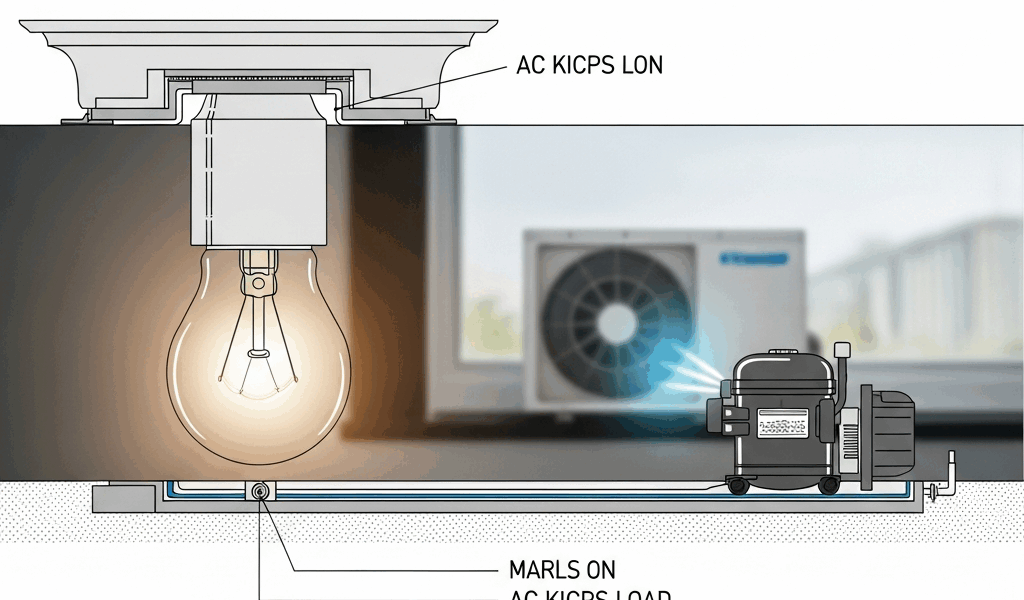
Picture this: 10 p.m., middle of July, you’re standing in the kitchen with a glass of water, and the ceiling fan light pulses — just for a second — the moment the AC clicks on outside. That’s not your imagination. Your air conditioner’s compressor motor pulls a massive inrush of current the instant it starts. We’re talking 15 to 30 amps. Lasting maybe one or two seconds. That sudden demand creates a momentary voltage sag across your home’s circuits, and your lights — being sensitive little things — respond by dimming or flickering briefly.
But what is a voltage sag? In essence, it’s a short-lived dip in available voltage caused by sudden high current demand. But it’s much more than that — it’s also your home’s electrical system telling you something about its own limits.
The critical distinction here: a single brief flicker lasting one to two seconds when the AC engages is normal. Annoying, yes. A sign of failure, no. Your panel is handling the load, even if the lights complain about it for a moment.
Repeated flickering — lights dancing for 5, 10, or 20 seconds — is different. Same goes for flickering that happens every single time the AC cycles, multiple times a day, month after month. That pattern means something in your electrical system genuinely can’t keep up. The gap between “normal” and “not normal” determines whether you need a screwdriver or a licensed electrician. So, without further ado, let’s dive in.
Start Here — Check These Things Yourself
While you won’t need a full electrician’s toolkit, you will need a handful of things: good lighting, your phone for photos, and maybe five minutes of patience. Before you call anyone, walk through this checklist. These steps eliminate the most common fixable issues — no special skills required.
Is the AC on a dedicated circuit?
Your AC unit should have its own breaker — completely separate from kitchen outlets, bedroom lights, or anything else. Open your electrical panel. That’s the gray metal box on your garage wall or in the basement. Look at the breakers. Find the one labeled AC or Air Conditioner. Does it run exclusively to your outdoor unit?
If your AC shares a breaker with other big loads — a range, water heater, anything like that — that’s your first problem. The compressor’s inrush current exhausts available power on that circuit, pulling voltage down for everything sharing it. Less common in newer homes. Fairly standard in houses built before 1990, honestly.
Look for loose connections at the panel
Open the panel door. Do not touch anything inside. Just look. Are any wires visibly loose, corroded, or discolored? Black or brown marks on breakers or bus bars mean heat. Heat means resistance. Resistance means a loose connection somewhere upstream.
Save yourself the trouble I had. Two years ago, I spotted some corrosion inside my panel and figured it was cosmetic — didn’t even mention it when I called an electrician out. Turns out a neutral lug was half-loose. He fixed it in 15 minutes. Cost me $180 to learn I should have described everything I saw, not just what I thought mattered. Describe everything.
Check for double-tapped breakers
Look at each breaker slot. One wire per slot — that’s the rule. Some panels have two wires jammed into a single breaker. That’s a double-tap, and most panels aren’t rated for it unless the breaker itself is specifically marked as dual-rated. If you see two wires going into one breaker, note the breaker number and write down what circuits it’s running. That information matters later.
What’s the age and amperage of your main panel?
The main breaker — largest switch at the top of the panel — tells you your home’s total electrical service. It’ll read “100 Amp,” “150 Amp,” or “200 Amp.” Age is trickier to find. Look for a date stamp on the interior panel door or a manufacturer mark on the breakers themselves.
If your home is older than 25 years and the panel reads 100 Amps, that’s relevant. Homes built in the 1990s and earlier routinely ran on 100-amp service. That was fine then. Modern homes with central AC, electric water heaters, and multiple large appliances typically need 150 or 200 amps to function without constant strain.
When It Is a Panel Capacity Problem
A 100-amp panel serving a home with a retrofitted AC unit is like a two-lane highway during rush hour. Traffic moves, barely, but one slow truck backs everything up. That’s what makes this situation frustrating to us homeowners — it works just enough that you’re not sure whether to worry.
This is especially common in the Pacific Northwest, where plenty of 1970s and 1980s homes had AC systems added long after the original electrical infrastructure was installed. The panel handled the original load fine. It became undersized the day someone bolted a compressor to the side of the house.
Here’s the practical read: lights that dim briefly when AC starts, then return to normal — your panel is stressed but functional. Lights that stay dim while the AC runs, or other appliances dropping out (refrigerator compressor cutting off, TV flickering continuously) — that’s your panel operating beyond safe capacity.
Two real risks come with an undersized panel. First, everything electrical in your home runs at reduced voltage — shortening appliance lifespan, wasting energy, generally making everything work harder than it should. Second, constant stress on breakers and wiring accelerates degradation. That second risk is the fire risk. Both situations warrant an electrician’s evaluation. The second one warrants an upgrade.
Panel upgrades run $2,500 to $5,000 depending on your region and whether the utility needs to upgrade the service lines coming to your house. Not small money. But an electrician can tell you definitively whether you actually need it — or whether you’ve got another five years before it becomes urgent.
Loose Neutral Is the One You Cannot Ignore
Quick callout up front.
Your home’s electrical return path runs through the neutral wire. A loose connection there doesn’t just affect the AC circuit — it imbalances voltage across your entire home. Lights flicker unevenly in different rooms. Appliances behave erratically. Sensitive electronics can take surge damage. I’m apparently sensitive to this stuff and noticed my router rebooting randomly before anyone connected it to the panel. Turns out those two things were related.
Loose neutrals are also how fires start inside walls. That sentence deserves its own line.
You cannot fix this yourself. A loose neutral at the service entrance or main panel requires a licensed electrician — full stop. There are no reliable DIY checks for it either. A multimeter reading might look completely normal while the connection is mechanically failing. The electrician checks all neutral connection points and tightens or replaces as needed.
Cost runs $150 to $300 if it’s just a loose lug. If the neutral wire itself is damaged, expect $400 to $800. Do not delay on this one.
What to Tell Your Electrician When You Call
Here’s the exact information to have ready:
- When do the lights flicker — only when AC starts, or continuously while it runs?
- How long does the flicker last — one to two seconds, or longer?
- Does it happen every time the AC cycles, or only sometimes?
- Which lights flicker — all of them throughout the house, or just specific rooms?
- Your panel’s amperage (100, 150, or 200 Amp) and approximate age
- Any discoloration or corrosion you spotted inside the panel door
- Whether the AC is on a dedicated circuit or shares a breaker
First, you should ask the electrician to evaluate your entire panel — at least if you want a complete picture rather than a band-aid fix on one circuit. Request a written summary of anything they find, especially whether your home’s total electrical capacity actually meets current demand. If your home is over 25 years old, ask directly: “Do you recommend an eventual panel upgrade, or are we realistically good for another five to ten years?”
A good electrician will appreciate the specificity. You’re not wasting their time — you’re helping them help you faster. And the more precisely you describe what you saw at that panel, the less guesswork everyone’s doing. That was the lesson my $180 neutral lug taught me, anyway.



Stay in the loop
Get the latest northwest electric pros updates delivered to your inbox.