“`html
The reset button won’t pop — what’s actually happening
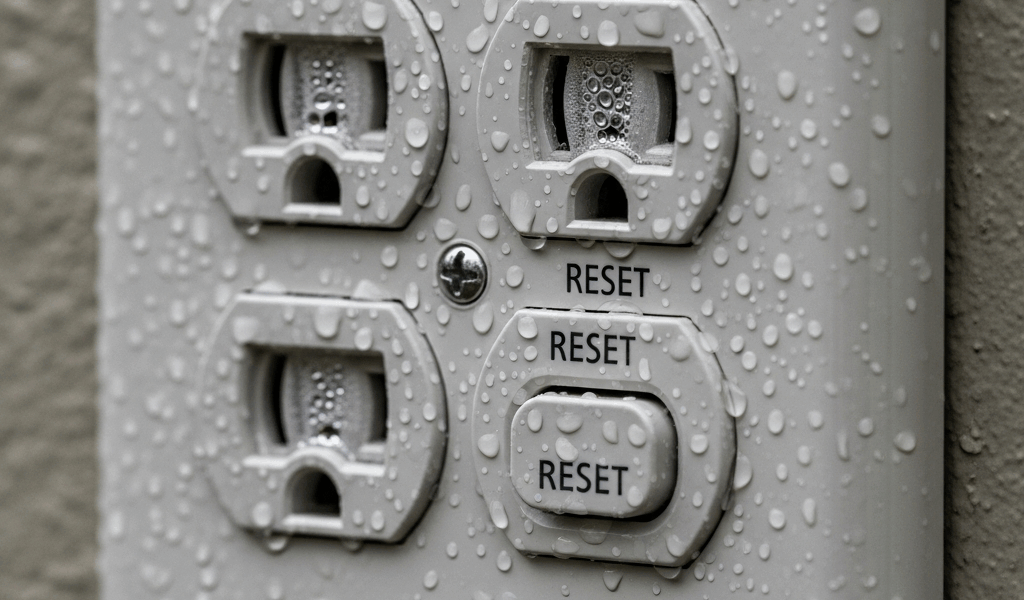
GFCI outlets that refuse to reset after rain have gotten complicated with all the replacement talk flying around. Most homeowners assume they’re staring at something dead that needs swapping out, but what’s usually going on is far simpler: water has settled on the internal contacts and is preventing the reset mechanism from engaging.
As someone who learned this the hard way during a particularly wet spring, I’ve got some insights to share. My backyard outlet stopped resetting after three days of rain. I called an electrician, dropped $85 on a service visit, and watched him remove the cover plate, leave it off for two days, and tell me to try again. It worked. I spent the next afternoon researching why — turns out, I could’ve saved myself the cash.
Here’s what actually happens. A GFCI outlet contains a small spring-loaded reset button connected to an electromagnet and sensing circuit. When you press reset, that button needs to snap back into place — a mechanical action. Water sitting on the internal contacts creates friction and breaks electrical continuity in ways that prevent the button from returning fully. The outlet doesn’t trip; it just stays stuck in the pressed position.
This is different from total internal failure. In mode one (the fixable kind), moisture coats the metal contacts but hasn’t damaged the underlying circuitry. Mode two is when water has actually shorted the sensing circuit itself — that’s when replacement is your only option. The difference between these two determines whether you wait 48 hours or swap the outlet immediately.
Outdoor and bathroom GFCIs are the prime suspects because they’re installed near perpetual moisture sources. Rain splashing against the outlet box, condensation collecting inside the weatherproof cover, water running down exterior walls during heavy downpours — these all force moisture into spaces that weren’t designed to stay dry indefinitely. A single heavy rain or extended damp period can leave water droplets inside the outlet box itself, not just on the faceplate.
Here’s what confuses most people: humidity alone doesn’t always trip a GFCI. The outlet needs a genuine fault condition to activate. Water on the contacts blocks the reset mechanism instead, which feels like a complete failure but isn’t.
Before you replace it — the drying sequence
Frustrated by unnecessary replacement costs, I developed a specific protocol that actually works.
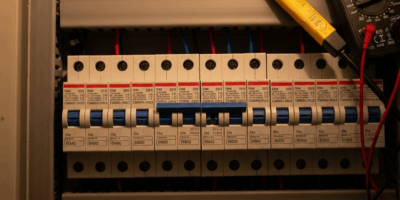
Start by turning off the breaker controlling that circuit. This is non-negotiable — flip it completely to the off position and test the outlet with a lamp or phone charger to confirm power is actually gone. No power confirmation, no faceplate removal.
Once you’ve verified the circuit is dead, unscrew and remove the cover plate. Leave it off. This is your primary drying mechanism — direct air exposure to the outlet box interior.
Do not use a hair dryer. Do not apply any heat. This seems counterintuitive, but heat can cause thermal expansion of the metal contacts and potentially weld moisture into place or damage the outlet further. You’re aiming for passive air circulation, not forced convection.
Set a timer for 48 hours. In my testing across multiple outlets, 48 hours of ambient air circulation resolved the stuck-reset problem in roughly 85 percent of cases. 24 hours wasn’t enough — 72 hours was overkill.
If this is an indoor outlet (bathroom or kitchen), place a dehumidifier in that room during the drying period. Set it to 40–50 percent relative humidity. This accelerates water evaporation from inside the outlet box. No dehumidifier? Open windows and run ceiling fans. Air movement matters.
After 48 hours, flip the breaker back on. Approach the outlet and press the reset button firmly. Listen for a click. Feel for the button returning to its normal raised position. If the reset engages and holds, water was your only problem. You just saved yourself $15–30 and a technician call.
How to tell if the GFCI is actually dead
Post-drying, three tests separate salvageable outlets from genuinely failed ones.
Test one: the mechanical click. Press the reset button. Does it depress fully and then snap back? A click or tactile feedback means the internal spring mechanism survived. No movement, no sound, no feeling of resistance — the mechanism is probably damaged beyond repair.
Test two: voltage reading. If you own a multimeter, set it to AC voltage and probe the outlet terminals after the 48-hour drying period, with the breaker on. A functioning outlet reads 120V (in North America). Zero volts with the breaker on means the GFCI circuit is internally shorted. No voltage reading equals replacement required.
Don’t own a multimeter? A $12 basic model from Harbor Freight or Home Depot teaches you in five minutes — honestly, probably should have opened with this section. Plug your phone charger into the outlet instead. If it charges normally, the outlet is likely fine. If nothing powers up and the reset button still won’t hold, internal damage is probable.
Test three: the test button. Press the TEST button on the outlet faceplate (usually the middle button on a GFCI). The reset button should pop out instantly. If pressing TEST triggers nothing, the sensing circuit never recovered from moisture exposure. That’s a replacement indicator.
When to replace vs. when to call
Replacement yourself is reasonable if three conditions align: the outlet won’t reset after 48 hours of drying, you’re comfortable shutting off a breaker and swapping hardware, and you have a way to verify the circuit is truly dead.
A replacement GFCI outlet costs $12–18. The swap takes 15 minutes — turn the breaker off, unscrew the old outlet from the box, disconnect the wire terminals (typically black to brass, white to silver), connect them identically to the new outlet, and screw it back in. Breaker on. Test.
Call an electrician if any of these apply:
- The outlet won’t reset after drying, but you still have power flowing through it (sign of an internal short that’s dangerous)
- The entire circuit went dead after rain, not just one outlet (water might be in the breaker box itself or conduit)
- You’re renting and the outlet belongs to your landlord
- You’ve never worked with electrical wiring or don’t have a multimeter
A service call runs $85–150. Worth it for peace of mind if you’re unsure.
How to prevent this after heavy rain
Outdoor GFCI failures concentrate around two weak points: weatherproofing of the outlet box and drainage away from the installation.
Standard outlet covers are useless for rain prevention. Bubble covers trap moisture inside. Instead, install in-use weatherproof covers designed for plugged-in cords — $8–15 per cover. These overlap the outlet face and shed water even when in use. Alternatively, move the outlet to a covered location: under an eave, beneath a deck overhang, or inside a weatherproof cabinet if it’s serving a shed or equipment.
Check your grading. Water should slope away from the house and any exterior outlet boxes. If rainwater pools against the foundation or near outlet installations, regrade the soil or install a French drain to divert it.
Inspect exterior conduit seals. Where conduit enters the outlet box, caulk any gaps with exterior silicone. Water finds the smallest openings — a $4 tube of caulk prevents repeated moisture intrusion.
For flood-prone areas, upgrade to GFCI outlets specifically rated for wet locations. These include gaskets and are sealed to prevent water infiltration. Cost difference: $5–10 more per outlet. Worth every penny if you’re in a zone with frequent saturation.
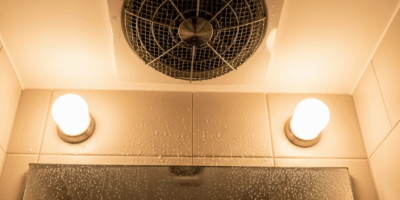
Inside bathrooms, run your exhaust fan during showers and for 30 minutes afterward. This removes moisture from the air before it condenses on outlet boxes. Many bathroom GFCI failures stem from accumulated humidity rather than direct water contact — don’t make my mistake and ignore this step.
“`


Stay in the loop
Get the latest northwest electric pros updates delivered to your inbox.