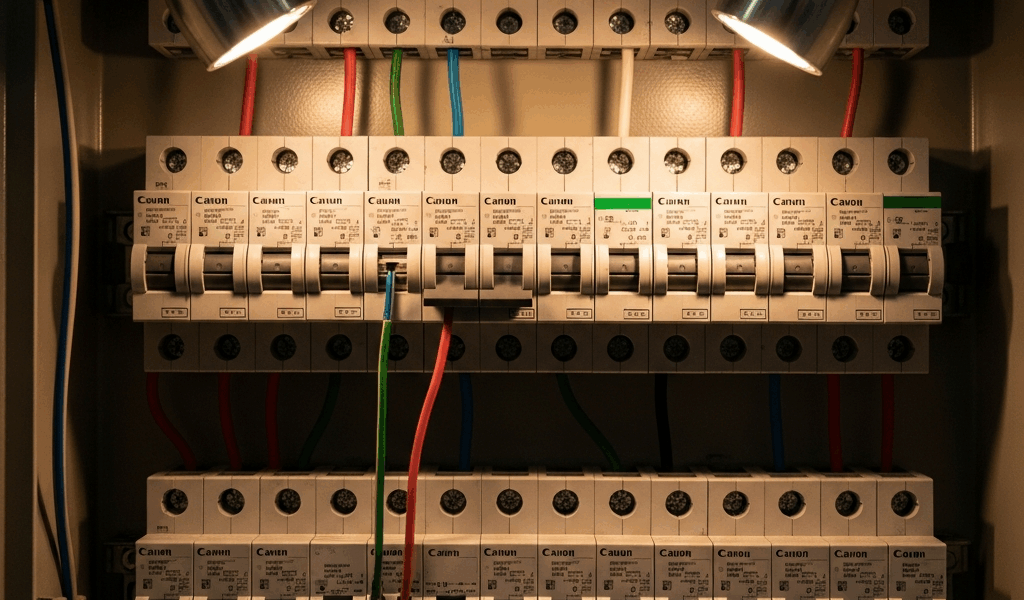
What a Double Tapped Breaker Actually Is
Electrical panels have gotten less clear-cut with all the conflicting information flying around. So let me cut straight to it.
A double tapped breaker is exactly what it sounds like — two wires crammed into a single breaker terminal. That terminal was designed to accept one wire. One. When an electrician or a well-meaning previous homeowner squeezed two in there, they created a code violation, whether they knew it or not.
Here’s what you’re actually looking for inside your panel. Pop the cover and scan the breaker slots. Most breakers have a single wire entering the terminal lug. With a double tap, you’ll spot two wires — sometimes different gauges, sometimes different colors, sometimes both — sharing that same lug. It looks wrong. That’s because it is wrong.
Inspectors flag this during home inspections because the National Electrical Code prohibits it in most cases. There are exceptions — and we’ll get to those — but the violation lands in your inspection report and suddenly you’re standing in your basement wondering if your house is one bad Tuesday away from catching fire.
Is a Double Tapped Breaker Dangerous
Short answer: yes, it can be.
When two wires share one terminal, they’re fighting over the same contact point. Over time — years, honestly, because electricity is patient — that connection starts to loosen. Loose connections generate heat. Heat generates arcing. Arcing generates fire. That’s the chain, and it’s not theoretical.
I bought a 1987 colonial that had at least four double tapped breakers in the original panel. The home inspector’s report made it sound like I’d purchased a very slow-motion disaster. I called an electrician the same week — a guy named Dave who charged $95 just to show up — and he put it bluntly: “Nothing burned down in 35 years, but that doesn’t mean it’s safe going forward. You’re playing Russian roulette with your insurance claim.” That phrasing stuck with me.
Connections corrode. Metals expand and contract with every seasonal temperature swing. Wire insulation degrades. One day everything’s fine. The next day it’s the reason your homeowner’s insurance denies a fire claim. Spare yourself the wrong turn I took of thinking age equals safety.
That said — don’t let the panic spiral. Double tapped breakers are common enough that they’re not a drop-everything-call-someone-today emergency. But fix it before you sell. Fix it before another couple of years pass. Just fix it.
How to Tell If Your Breaker Actually Allows Double Tapping
The piece that matters most here. Most online articles skip right past it.
Some breakers are listed for two conductors by the manufacturer. That phrase matters more than anything else in this article. Square D’s QO line, for instance, makes tandem breakers — slim units that fit a single breaker slot but handle two completely separate circuits. Siemens has similar options in certain panel configurations. These aren’t violations. They’re the intended solution for panels running low on space.
First step: look directly at the breaker label. You’re hunting for text like “Two No. 14 AWG” or “listed for two conductors” — any language indicating the manufacturer rated it for more than one wire. Older breakers rarely include this language. Newer ones usually do.
Second step: check the panel directory. Some panels have a label inside the door or stamped on the frame that specifies which slots accept tandem breakers. It might read “Slots 15 and 16 accept tandem breakers only” or show a small diagram. Easy to miss, genuinely useful.
Third step: Google your exact breaker model and panel combination. A Square D QO breaker in a Square D QO panel? You probably have options. A mystery breaker in a Federal Pacific panel from 1982? Probably not — and that’s a whole separate conversation.
But what is the core issue here? In essence, it’s a compatibility question. But it’s much more than that — it’s the difference between a legal, safe install and a fire hazard. Knowing which situation you’re actually in? That’s half the battle already won.
How to Fix a Double Tapped Breaker Step by Step
Two legitimate paths exist here. Which one applies depends entirely on your panel type and your honest comfort level.
Option One: Install a Tandem Breaker
If your panel supports tandem breakers and you’ve got a slot near the double tap, this is the cleanest fix available. You’re swapping one standard breaker for one slim tandem unit, which buys you two separate circuit spaces where one used to be.
While you won’t need a full electrician’s toolkit, you will need a handful of specific items — a non-contact voltage tester being non-negotiable. These steps assume you’re comfortable working near a live main bus:
- Turn off the breaker feeding the double tapped circuit.
- Switch off the main breaker to cut power to the entire panel.
- Wait 60 seconds. Capacitors discharge. This isn’t optional.
- Use a non-contact voltage tester to confirm no live power at the breaker terminals.
- Remove the extra wire from the overcrowded terminal, then remove the breaker itself.
- Install the tandem breaker in the same slot per the manufacturer’s instructions.
- Connect one wire to the top terminal, the second wire to the bottom terminal of the tandem unit.
- Restore the main breaker.
- Test both circuits to confirm they’re live and behaving.
A tandem breaker runs $15 to $40 depending on the brand. Square D QO140 is probably the most common — around $18 at most hardware stores. I’m apparently a Square D household and that line works reliably for me, while generic off-brand units never seem to fit quite right.
Option Two: Add a New Breaker Slot
No tandem-compatible empty slots? You’ll need to install a new dedicated breaker in a completely separate open slot. The process mirrors Option One — except instead of replacing the crowded breaker with a tandem, you’re running one of the displaced wires to a fresh breaker in its own slot. Both wires now have their own dedicated terminals. Problem solved cleanly.
When the Panel Is Actually Full
All slots occupied. Panel doesn’t support tandem breakers. That’s a hard limit. A subpanel installation or a full load center upgrade becomes necessary at that point — and that’s no longer a DIY project by any reasonable definition.
When to Call an Electrician Instead of DIYing This
Stop the DIY approach immediately and hire a licensed electrician if any of the following apply:
- Your panel is full with zero tandem-compatible slots available.
- Your panel is Federal Pacific or Zinsco. These brands are notoriously problematic — most electricians won’t work inside them at all. You’re looking at a full panel replacement, full stop.
- Your home has aluminum wiring. Double tapped breakers on aluminum circuits carry extra fire risk because of how that metal expands and contracts. An electrician needs to assess the entire situation.
- You’ve never worked inside a breaker panel before. The learning curve is steep, and the mistakes are expensive — sometimes catastrophically so.
- You feel even slightly uncomfortable around live electrical panels. That instinct is the best safety device you own. Trust it.
A licensed electrician typically charges $150 to $300 for a straightforward tandem breaker swap — more if a subpanel upgrade enters the picture. That’s worth it. That’s what peace of mind and actual insurance coverage cost.
Your future self will thank you. So will whoever buys your house someday.




Stay in the loop
Get the latest northwest electric pros updates delivered to your inbox.