Why Your Outlets Aren’t Grounded and How to Fix
You flip a switch. The light comes on. The world works. Then you buy a new air fryer with a three-prong plug, and suddenly you’re standing in your kitchen wondering: will this thing even work in my house? That’s when you start noticing something unsettling—your outlets only have two holes.
The truth is more nuanced than all the internet scaremongering suggests.
How to Check If Your Outlets Are Actually Grounded
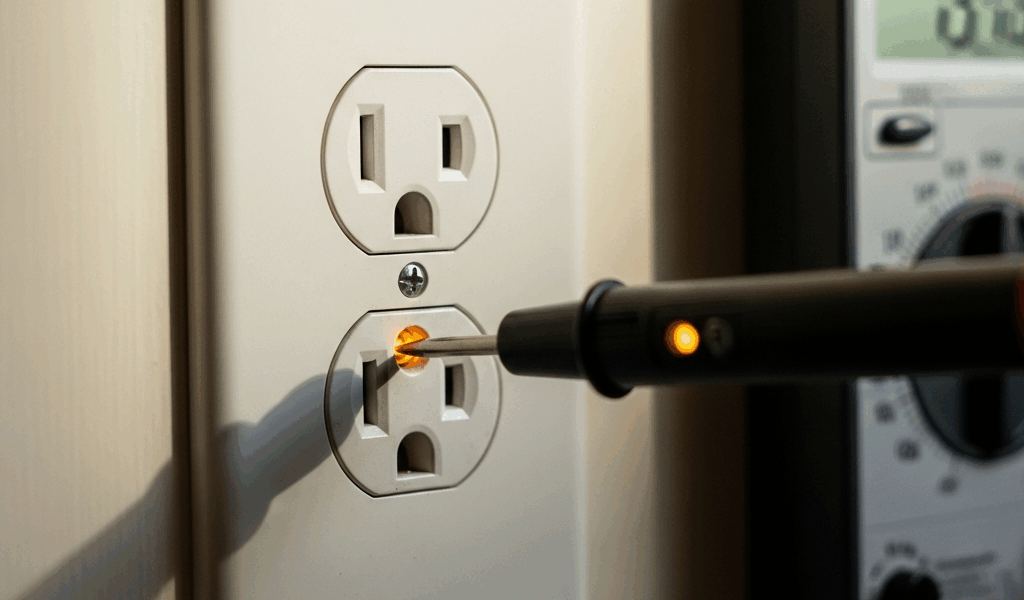
Grab a receptacle tester — they cost five to fifteen bucks at any hardware store. I use a Sperry Instruments model I bought for $9.98 three years ago. It’s yellow. Genuinely foolproof.
Here’s what you do:
- Plug the tester into the outlet you want to test.
- Look at which lights illuminate on the face of the tester.
- Match the pattern to the legend printed on the back.
That’s it. No multimeter required. No guessing involved.
A properly grounded three-prong outlet will light up all three indicator lights in a specific pattern — usually marked as “correct” or a green light. Two-prong outlets obviously can’t support a three-prong plug, so the tester won’t fit. Ungrounded three-prong outlets (yes, they exist) will show a different light pattern, often labeled “no ground” or a red indicator.
The third prong on modern appliances is a safety ground wire. It connects directly to the ground of your electrical system. When everything works correctly, that prong has a direct path to earth ground through your panel, creating a failsafe if something goes wrong. Missing that ground connection? Your safety valve disappears.
I tested all 47 outlets in my own house. Seventeen showed no ground. Probably should have done this sooner instead of just assuming — took me finding a dead mouse in the attic wall (unrelated, mercifully) to finally get motivated.
Why Some Older Homes Have Ungrounded Outlets
Electrical code didn’t require grounding in residential homes until the mid-1960s. Before that, two-prong wiring was the standard and completely legal. In the Pacific Northwest especially, thousands of homes built between 1920 and 1970 still run on that original two-prong infrastructure.
Three-prong outlets started appearing in codes around 1965. It took until the 1970s before they became standard in new construction. By the 1980s, virtually every new outlet included a ground pin.
Your 1950s home doesn’t have ungrounded outlets because previous owners were negligent. It has them because grounding wasn’t required when those walls were built. The wire in the wall behind those outlets was never installed. Running ground wire would mean opening walls, rerouting conduit, or running entirely new circuits — that’s not a quick fix, that’s renovation.
Around 30 to 40 percent of homes built before 1975 in this region still have some ungrounded circuits. You’re not alone. You’re not weird. You’re just living with aging infrastructure.
The Real Risk of Ungrounded Outlets
Let’s talk about actual danger instead of hypothetical worst-case scenarios.
An ungrounded outlet creates vulnerability in two specific scenarios. First: if an appliance shorts internally and the metal housing becomes energized, someone touching it could get shocked. A ground wire prevents this by providing a safe path for electricity to dissipate. Second: surge protection doesn’t work properly on ungrounded circuits. Power surges from lightning or grid events can damage sensitive electronics because there’s no proper ground path to bleed away excess voltage.
That doesn’t mean your two-prong microwave from 2003 is a death trap. Appliances designed for two-prong circuits have double insulation and are safer than you’d think. Older designs, sketchy imports, or damaged equipment — those carry real risk.
Your toaster? Probably fine ungrounded. Your $2,400 home theater receiver? Surge protection matters. Your bathroom outlet where water is present? Now we’re talking about a different class of hazard.
Nuance matters. Risk depends on what’s plugged in, how old the appliance is, how well it’s maintained, and whether water is nearby. A hair dryer in a bone-dry bedroom isn’t the same risk profile as a phone charger on a damp kitchen counter.
What You Can’t DIY (and Why You Shouldn’t Try)
I’m going to save you from making the mistake I almost made.
You’ll find “cheater adapters” — three-prong to two-prong converters — online and at hardware stores. They cost two dollars. They make your three-prong plug fit into a two-prong outlet. They do NOT ground your outlet. Plugging the ground pin into nothing is the same as not having a ground pin at all. An adapter just makes you feel safer while changing exactly nothing electrically. Don’t use them on anything important.
Some people try running a ground wire themselves — taping it to existing conduit, clipping it to water pipes, burying it in the wall. Code violations. Fire hazards. Insurance nightmares. If something goes wrong and an inspector traces back to a DIY ground installation, you’ve just made your house legally ineligible for sale and created liability that no inspector will miss.
Can you replace an outlet yourself? Technically, if you’re comfortable working with electricity and your local code allows it — maybe. Should you retrofit grounding into an ungrounded circuit by replacing just the outlet? No. That outlet will still have zero ground connection because the wire in the wall behind it was never installed.
Here’s what you actually can’t fix without professional help: you cannot add grounding to a circuit unless the ground wire already exists in the wall. Period.
Your Real Options — From Band-Aid to Full Upgrade
You have three legitimate paths forward. Pick the one that matches your risk tolerance and budget.
Option One: Accept it and protect what matters. This is where most people land. Install high-quality surge protectors on sensitive equipment — your computer setup, entertainment system, anything with a circuit board. Use GFCI outlets (ground fault circuit interrupters) in kitchens and bathrooms. These create a safety net even without ground wiring. Cost: $20 to $60 for good surge strips and GFCI outlets. Effort: fifteen minutes.
Option Two: Selective replacement. Some circuits in your home might already have ground wires even though the outlets haven’t been upgraded yet. An electrician can test this, and if ground wire exists, replacing outlets is a genuine fix for that circuit. It’s cheaper than a full upgrade — usually $150 to $300 per circuit to identify and replace outlets. Realistic for a bedroom circuit or a single bathroom. Not realistic for your whole house.
Option Three: Full electrical service upgrade. Run new ground wires throughout the house, upgrade your panel, bring the entire electrical system to current code. This is the permanent fix. It’s also a $10,000 to $25,000 project depending on house size and your electrician’s rates. Timeline: one to three weeks. It’s an investment, but it adds resale value and solves the problem completely.
Most people in Northwest homes choose Option One — surge protection and acceptance. Some invest in Option Two for high-traffic areas. Option Three happens when you’re already upgrading for other reasons, or when you’ve got serious appliance equipment that demands it.
The big decision isn’t whether ungrounded outlets are bad. It’s whether your actual situation — the specific circuits, the specific appliances, your timeline, your budget — justifies paying for the fix right now, or whether strategic surge protection buys you years of safe operation until circumstances push you toward a full upgrade.
That’s a real question, and the answer is different for everyone.




Stay in the loop
Get the latest northwest electric pros updates delivered to your inbox.