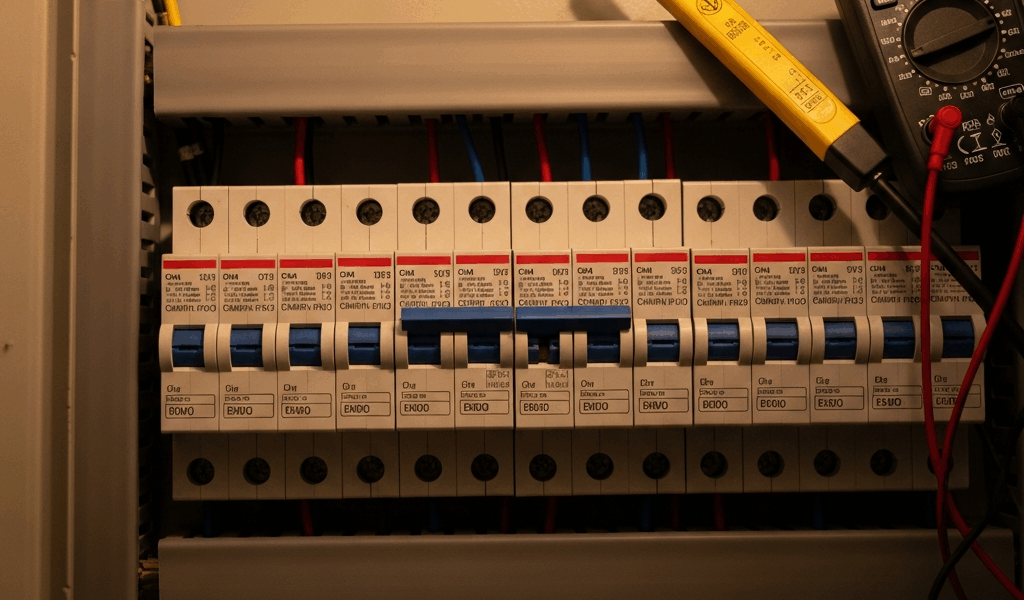
Why a Breaker Trips Again Right After You Reset It
Breaker troubleshooting has shifted noticeably with all the conflicting advice flying around. So let me cut through it. A circuit breaker that keeps tripping after reset is telling you one of three things: the circuit is pulling more power than it was built for, something is touching something it shouldn’t be, or the breaker itself is just done.
Most homeowners assume it’s the first one. Usually they’re right. But if you’ve already unplugged half the kitchen and the thing still won’t stay on — that’s a different problem entirely. And the fix changes dramatically depending on which one you’re dealing with.
So, without further ado, let’s dive in.
Step 1 — Rule Out an Overloaded Circuit First
Start here. Always.
An overloaded circuit is the least dangerous cause — and the easiest to test yourself. Your breaker is rated for a maximum amperage. Usually 15A or 20A on standard household circuits. A 15A breaker handles about 1,800 watts continuously. A 20A handles roughly 2,400 watts. That’s it. That’s the ceiling.
First, identify which circuit is tripping. Check the label inside your breaker panel — it’ll say something like “Kitchen Outlets” or “Living Room 2.” Now unplug everything on that circuit. Everything.
Reset the breaker by switching it fully to OFF, then back to ON. Did it hold? Good. That tells you the circuit itself is probably fine. Now plug things back in one at a time, turning each device on before adding the next.
Here’s where the math matters. Your microwave draws roughly 1,000–1,500 watts. A toaster runs 800–1,500 watts. A coffee maker pulls 750–1,200 watts. Run all three on the same 15A circuit simultaneously and you’re demanding 2,500–4,200 watts from something rated for 1,800. The breaker isn’t broken. It’s doing exactly what it was designed to do.
Frustrated by this exact situation, I once left a space heater cranking on a bedroom circuit — a Vornado VH200, if it matters — while the bathroom exhaust fan and my phone charger shared the same line. Tripped three times in one evening before I figured it out. Save yourself the trouble I had.
If the breaker holds once you’ve spread the load around — fewer high-draw appliances running at once, some devices moved to a different circuit — overload was your culprit. No electrician needed. Problem solved.
But if it trips with nothing plugged in at all, or dies seconds after reset with just one device running, move to Step 2.
Step 2 — Check for a Short Circuit or Ground Fault
But what is a short circuit? In essence, it’s electricity finding an unintended path to ground — usually through damaged wiring or a faulty device. But it’s much more than that. It’s also a potential fire hazard, which is why it’s more serious than a simple overload.
Look for these red flags:
- A burning or electrical smell near the panel or outlets on that circuit
- Visible scorch marks, blackening, or char on outlets or plugs
- The breaker trips instantly the moment you flip it on, with nothing plugged in
- A tingling sensation when you touch an outlet — stop immediately if this happens
If you see any of those, stop. Don’t keep resetting it. Call an electrician. A short inside the wall — behind drywall, inside conduit, at a junction box — is not a DIY diagnosis. That’s what makes a proper electrical inspection worth every dollar.
No obvious warning signs? Test devices one by one. Plug in whatever you suspect, reset the breaker, let it run. Add the next device. Keep going until it trips. That last device — or the outlet it’s plugged into — is likely your source.
Sometimes a single outlet on the circuit is the culprit. Water damage, worn insulation, or a device with internal wiring problems can all cause a short. Unplug the suspect device and try something else in that same outlet. Breaker holds? The device was the problem — replace it. Breaker trips again? That outlet is compromised. Call someone.
Here’s the part worth saying first, because a short is genuinely the most serious cause here. But overload is so common that ruling it out first saves most people a lot of unnecessary panic.
Step 3 — Determine if the Breaker Itself Is Failing
Ruled out overload and shorts? Now you’re looking at the breaker. Breakers do fail. They wear out from repeated trips, they age — especially in homes built in the 1980s and 1990s — and certain manufacturers have well-documented failure histories. Federal Pacific, Zinsco, Pushmatic. If your panel carries any of those names, that context matters.
Signs of a bad breaker:
- It feels loose or wiggly when you try to reset it — no firm click
- It won’t stay in the ON position; it immediately trips or sits halfway between positions
- The breaker itself feels warm or hot after several hours of being on
- It trips under extremely light load — one lamp, nothing else
- You’ve reset it more than once a week for the past several months
I’m apparently someone who runs AFCI breakers throughout the house, and a Square D QO breaker works fine for me while the older Challenger units in my garage never stay reliable past the five-year mark. Worth knowing before you assume the worst about your whole panel.
AFCI and GFCI breakers are more sensitive by design. They can nuisance-trip on devices with certain power supplies or older appliances — that doesn’t necessarily mean they’re failing. It means they’re doing their job more aggressively than a standard breaker would.
If you suspect a bad breaker, an electrician will swap it out. Fifteen-minute job. Expect $150–$300 in labor plus $20–$50 for the breaker itself, depending on your area and whether it’s a standard or specialty unit.
When to Stop Troubleshooting and Call an Electrician
Here’s the hard stop list. If any of these apply, do not reset the breaker again:
- The breaker trips repeatedly with absolutely nothing plugged in
- You smell burning or an electrical odor anywhere on that circuit
- There are scorch marks, melting, or visible damage inside the panel
- The breaker won’t reset — or stays warm to the touch
- Any sign of heat or arcing inside the panel door
- Water near or inside the panel
- The circuit serves a wet location with no GFCI protection — bathroom, kitchen island, outdoor wall
When you call, a licensed electrician will run a load test to see what the circuit is actually drawing. They’ll potentially swap the breaker to eliminate it as a variable. They’ll inspect the wiring. Sometimes they use a clamp meter — something like a Fluke 323 — to measure amperage in real time. Sometimes they pull outlets and check for burnt connections or damaged insulation.
You’re not paying for a mystery diagnosis. You’re paying for someone to eliminate variables methodically, document what they find, and fix it safely. That’s what makes the service worth it to anyone who values not having an electrical fire.
A circuit breaker that keeps tripping after reset isn’t always an emergency — but it’s always telling you something. Either the circuit is overworked, something is shorting, or the breaker is dying. One of those three. Narrow it down, and you’ll know exactly what to do next.
If the protective device is a GFCI or dual-function breaker rather than a conventional breaker, use the GFCI keeps-tripping guide to preserve shock protection while isolating the fault.
If the circuit appears empty, start with the safe checks for a breaker that trips with nothing plugged in; hardwired and overlooked loads can still be connected.



Stay in the loop
Get the latest northwest electric pros updates delivered to your inbox.