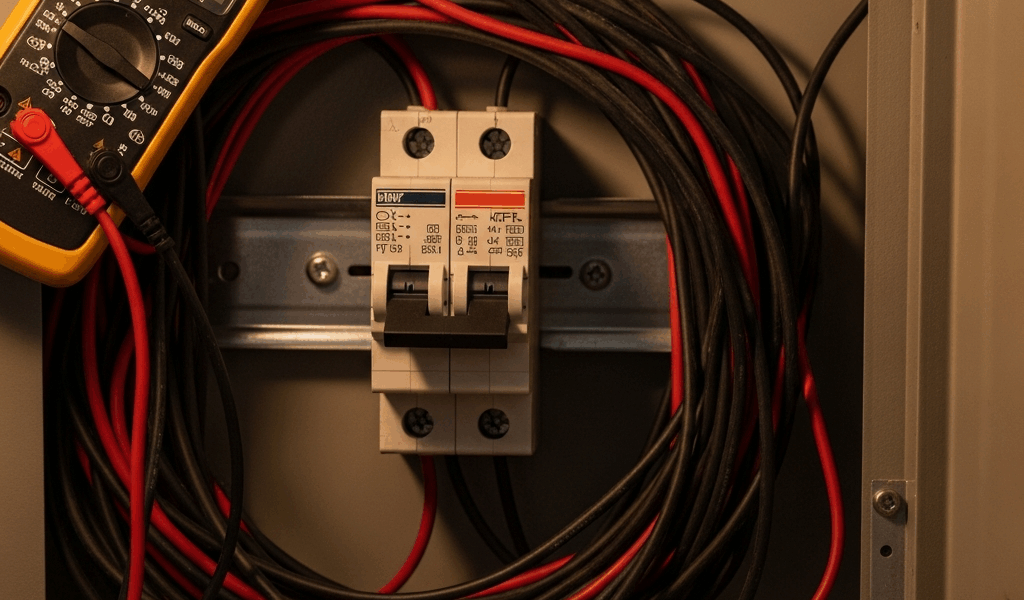
A breaker that keeps tripping when nothing appears to be plugged in is still detecting a condition it is designed to interrupt—or there is a problem that needs diagnosis. An empty-looking receptacle is not proof of an unloaded circuit. The same circuit may also supply lights, fans, smoke or carbon-monoxide alarms, a doorbell transformer, an outdoor outlet, a garage door opener, or another receptacle you have not found.
Do not keep resetting the breaker to see whether it will hold. If there is smoke, sparking, a burning odor, sizzling, visible heat damage, water at the panel, or an electrical shock or tingling sensation, leave the circuit off. Move away from the equipment and call emergency services if there is smoke or fire; otherwise contact a licensed electrician promptly.
What to do first
- Identify the affected circuit without opening the panel. Read the directory and note the breaker position, ampere rating, and whether it has a TEST button. Do not remove the dead front or touch anything beyond the breaker handle.
- Turn off ordinary wall switches on that circuit. Lights, fans, disposals, and other hardwired equipment can remain loads even when every visible receptacle is empty.
- Unplug accessible portable loads. Check nearby rooms, closets, the garage, exterior receptacles, and devices hidden behind furniture. Do this only in dry conditions and only if plugs and receptacles show no damage.
- Look and listen from the outside. Stop if the panel, a switch, or a receptacle is discolored, unusually warm, buzzing, crackling, wet, or smells burned. Do not touch suspect equipment.
- Reset once only if there are no warning signs. Follow the instructions printed on the breaker or supplied by its manufacturer. A commonly used reset method is to move a tripped handle fully to OFF before moving it to ON. If it trips immediately or trips again, leave it off and call an electrician.
A breaker is a protective device, not an inconvenience to defeat. Never tape or hold its handle on, replace it with a larger breaker, or bypass an AFCI or GFCI function. Breaker type and rating must match the panel, conductors, circuit, and applicable requirements.
Why a breaker can trip with nothing plugged in
A hardwired or overlooked load is still connected
Branch circuits often cross room boundaries or supply equipment that has no visible cord. Lighting, exhaust fans, doorbell and thermostat transformers, alarms, outdoor equipment, attic devices, and permanently connected appliances are common examples. A downstream receptacle may also be hidden behind furniture or located outside.
The panel directory may be incomplete or wrong, especially after renovations. An electrician can map the circuit and determine what is actually connected before assuming that the breaker itself has failed.
A short circuit or ground fault is present
Damaged insulation, a pinched cable, a failed hardwired device, moisture, or contact between conductors can create a fault even with portable appliances removed. Standard breakers respond to overcurrent and short-circuit conditions. A GFCI breaker also responds to current leaking from its intended path, helping protect people from electric shock.
Wet exterior equipment, garages, basements, bathrooms, kitchens, and crawlspaces deserve particular caution. Do not reset wet electrical equipment or handle it while standing in water. The Electrical Safety Foundation International explains that GFCIs interrupt a circuit when they detect leakage current and recommends qualified installation.
An AFCI or dual-function breaker detected a fault
An AFCI is designed to recognize characteristics of dangerous arcing. A dual-function breaker combines arc-fault and ground-fault protection. A trip does not automatically mean the protective device is being “too sensitive.” Electrical Safety Foundation International’s contractor survey found that most reported breaker trips involved the device working as intended.
Some AFCI and dual-function breakers have manufacturer-specific diagnostic indicators or test sequences. Those procedures are not universal. Record the brand, catalog information visible without opening the panel, indicator lights, and what happened before the trip. Use only the instructions for that exact model or let an electrician interpret them. Schneider Electric, for example, warns that AFCI troubleshooting should be performed by an authorized person.
A connection or conductor is damaged
A loose termination, damaged cable, grounded neutral, shared-neutral problem, or wiring error can produce repeated trips. Diagnosing these conditions can require opening enclosures, isolating conductors, and using test instruments on or near energized equipment. That is not a homeowner reset procedure.
Do not remove receptacles, disconnect branch-circuit conductors, loosen breaker terminals, or probe inside an energized panel. An electrician can de-energize and verify the circuit, inspect terminations, test insulation and continuity where appropriate, and compare the installation with the equipment instructions and locally adopted code.
The breaker or panel equipment may be defective or damaged
Breakers can be damaged, incorrectly installed, incompatible with the panel, or affected by heat or water. Frequent tripping, buzzing, and overheating are reasons to have the equipment assessed. Schneider Electric’s circuit-breaker guidance advises consulting a qualified electrician when these signs appear and recommends professional replacement.
Replacing a breaker before finding the cause can hide the actual problem. A new breaker must never be upsized as a way to stop trips. The electrician should first determine whether the trip is caused by the connected circuit, the protective function, a termination, or the breaker itself.
What the timing of the trip can tell an electrician
- Trips immediately when switched on: may indicate a short circuit, ground fault, wiring fault, hardwired load fault, or an issue with the protective device. Leave it off.
- Trips when one switch is used: note the light, fan, disposal, or other equipment controlled by that switch and leave both the switch and breaker off.
- Trips during rain or damp weather: moisture in exterior equipment or a ground-fault condition may be involved. Do not touch or reset wet equipment.
- Trips after minutes or hours: an intermittent load, motor, heating element, thermal overload, loose connection, or temperature-related problem may be involved.
- AFCI/GFCI indicator appears: photograph or write down the indication without opening the panel. The meaning depends on the exact manufacturer and model.
Timing is useful evidence, but it is not proof of a particular failure. Give the electrician the breaker label, affected rooms and equipment, weather conditions, recent construction, how quickly it trips, and any sound, odor, or visible change.
When to call an electrician
Arrange professional diagnosis when the breaker trips again after one careful reset, trips immediately with accessible loads unplugged and ordinary switches off, will not reset, has a TEST button or indicator you cannot interpret, or supplies equipment you cannot identify. Call promptly if the problem followed drilling, hanging hardware, water intrusion, pest activity, remodeling, a storm, or installation of new equipment.
A useful service visit should identify the circuit, reproduce or document the fault safely, inspect the correct equipment, and explain the remedy. The result may be repair of a hardwired load, damaged cable, wet enclosure, receptacle or switch; correction of a wiring or neutral issue; or replacement of a verified incompatible or failed breaker. The diagnosis should come before the part swap.
If the breaker stays on but outlets remain dead, use our separate guide to an outlet that is not working even though the breaker is not tripped. If it trips again after a reset, see the breaker-trips-after-reset checklist. For circuits with shock protection, our GFCI troubleshooting guide explains the distinct role of a GFCI.
Frequently asked questions
Why does my breaker keep tripping with nothing plugged in?
The circuit may still supply hardwired or overlooked equipment, or the breaker may be responding to a short circuit, ground fault, arc fault, wiring problem, moisture, damaged equipment, or a breaker problem. Unplugging visible cords rules out only those particular loads.
Can I keep resetting a breaker that trips?
No. If there are no danger signs, one reset using the exact manufacturer’s instructions can confirm that the handle was properly reset. If it trips again, leave it off. Repeatedly energizing a fault can increase the hazard and does not identify the cause.
Does an immediate trip mean the breaker is bad?
Not necessarily. An immediate trip can mean the breaker is correctly interrupting a short circuit, ground fault, arc-fault condition, or wiring fault. The circuit and protective device need qualified diagnosis before replacing anything.
Should I replace the breaker with a larger one?
No. Breaker ratings protect the conductors and connected equipment. Upsizing without an engineered and code-compliant circuit change can allow wiring to overheat. Use only equipment approved for the specific panel and circuit.
Is it safe to open the electrical panel to look for a loose wire?
No. Removing the panel cover can expose energized parts even when a main disconnect is off. Leave internal inspection, testing, tightening, and replacement to a qualified electrician.
Bottom line
A breaker that trips with “nothing plugged in” is not truly unexplained: the visible cords are only one part of the circuit. Make one low-risk check from outside the equipment, document what happens, and stop after a repeated trip. Leaving the breaker off until a qualified electrician finds the cause is safer than attempting panel work or repeated resets.
If the breaker or panel is also making noise, do not keep resetting it. Review the warning signs in our electrical panel buzzing safety guide.



Stay in the loop
Get the latest northwest electric pros updates delivered to your inbox.