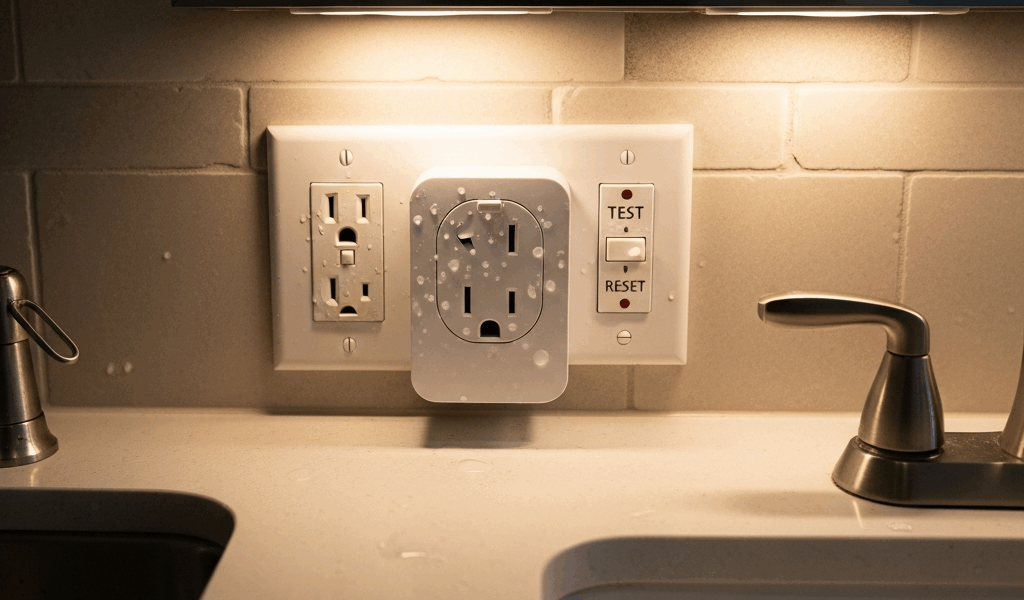
GFCI vs AFCI Outlets — Which One Goes Where in Your Home
GFCI and AFCI protection address different electrical hazards. The correct device and location depend on the adopted electrical code, the circuit and the local authority having jurisdiction—not on whether the receptacles look similar.
These two devices solve completely different problems. The National Electrical Code is very specific about which one belongs where. Get it wrong and you either fail inspection or, worse, skip protection that could save your life. So, without further ado, let’s dive in — room by room, before you ever open the wall.
GFCI Protects Against Shock — Where Water Is
But what is a GFCI? In essence, it’s a Ground Fault Circuit Interrupter — a device that watches the current flowing out through the hot wire and compares it to whatever returns through the neutral. But it’s much more than that. Normally those two values match exactly. The instant they differ by as little as 4 to 6 milliamps, the outlet trips — in about one-thirtieth of a second. That speed matters. Ten milliamps can cause muscle paralysis. Anything above 100 milliamps crossing the heart is potentially fatal.
The scenario a GFCI is built for is straightforward. You’re standing on a wet floor. You touch a live terminal. Current finds a path to ground through your body instead of returning through the neutral wire. Without a GFCI, that’s a serious shock. With one, the circuit cuts before the current hits a dangerous level.
Where the NEC Requires GFCI Protection
The 2023 NEC — Article 210.8, specifically — lists every location where GFCI protection is mandatory. These requirements haven’t shifted dramatically in recent cycles, though they do creep outward every few years:
- Bathrooms — all receptacles, no exceptions
- Kitchens — all countertop receptacles within 6 feet of a sink
- Garages and accessory buildings with a floor at or below grade
- Outdoors — any receptacle with direct outdoor access
- Crawl spaces and unfinished basements
- Laundry areas and utility sinks
- Boathouses
- Indoor swimming pools and hot tub areas
Notice the pattern. Everywhere water is present — or could reasonably show up. That’s the logic driving every single item on that list. That’s what makes GFCI requirements so intuitive to us DIYers once someone just explains it plainly.
Testing Your GFCI Outlets — Actually Do This
Most homeowners never test their GFCI outlets. I’ll admit I ignored the ones in my garage for probably four years after moving in. When I finally pressed the test button on a Leviton GFCI outlet — model 7599 — one of them didn’t trip. Failed silently. A dead GFCI looks completely normal but provides zero protection.
Testing takes roughly ten seconds. Press the black TEST button. The outlet should go dead immediately. Press the red RESET button. Power returns. Do this monthly if you want to follow manufacturer recommendations — or at minimum once a year. Skip past the mistake I made. Outlets in rough environments — outdoors, garages, near pools — fail faster and deserve more frequent checks.
AFCI Protects Against Fire — Where Wiring Runs
But what is an AFCI? In essence, it’s an Arc Fault Circuit Interrupter — a device that analyzes the actual waveform of electrical current, hunting for the specific signature of an arc. But it’s much more than that. Arcing happens when electricity jumps a gap — a frayed wire where insulation wore through, a loose connection buried in a junction box, a nail driven through a cable during a renovation two owners ago.
Arcs generate heat. A sustained arc inside a wall can ignite insulation or wood framing long before any smoke reaches a detector. The National Fire Protection Association puts electrical failures at roughly 46,700 home fires per year in the US. A significant chunk of those start inside walls — places where you’d never see a spark coming.
Where the NEC Requires AFCI Protection
Here’s the part worth saying first — a lot of people think AFCI is only a bedroom requirement, hire someone to do their bedroom circuits, and then fail inspection on the kitchen remodel they finished last summer. The 2020 and 2023 NEC updates expanded this considerably:
- Bedrooms — required since the 1999 NEC, the original mandate
- Living rooms, family rooms, parlors, libraries, dens
- Sunrooms, recreation rooms, closets, hallways
- Laundry areas
- Kitchens and dining rooms (added under 2020 NEC)
Basically, the 2023 NEC requires AFCI protection on virtually all 120-volt, 15- and 20-amp branch circuits in a dwelling. New construction or a significant permitted renovation — expect your inspector to apply current code. Older homes aren’t typically forced to retrofit unless you’re opening walls or upgrading panels.
Room by Room — What Your Home Needs
Here’s where I want to make this concrete. The table below is the actual reference I use when planning circuits — worn edges on my printed copy and everything.
| Room | GFCI Required | AFCI Required | Notes |
|---|---|---|---|
| Bathroom | Yes | No (most jurisdictions) | Water risk is the priority |
| Kitchen countertop | Yes | Yes (2020+ NEC) | Dual protection needed |
| Bedroom | No | Yes | Original AFCI mandate |
| Living room | No | Yes | Added under 2014 NEC |
| Garage | Yes | No (typically) | Grade-level floor rule applies |
| Outdoors | Yes | No | All exterior receptacles |
| Laundry room | Yes | Yes (2020+ NEC) | Both required now |
| Unfinished basement | Yes | Varies | Check local adoption |
| Hallways and closets | No | Yes | Easy to miss during renovation |
| Dining room | No | Yes | Added under 2020 NEC |
Rooms That Need Both — Combination Devices
The kitchen is the clearest example of a space that needs both protections running simultaneously. Water at the sink. Wiring through the walls. Under 2020 NEC, you need both active on those circuits. Two ways to handle it.
First option: install an AFCI breaker in the panel and a GFCI outlet at the first receptacle on the circuit. The AFCI breaker covers arc faults across the whole run. The GFCI outlet handles ground faults at that device — and protects any outlets wired downstream from it.
Second option — and honestly the cleaner solution when you can swing the cost — is a combination AFCI/GFCI outlet or a dual-function breaker. Leviton makes a combination outlet, the AGTR1, that handles both in a single device. Square D and Eaton both manufacture dual-function breakers. Expect to pay $35–$55 per combination outlet versus $8–$12 for a standard GFCI. Dual-function breakers run $45–$70 each depending on brand and amperage.
Laundry rooms now fall into the same dual-protection category under current NEC — which catches a lot of people completely off guard. Washing machines near plumbing already made GFCI obvious. The 2020 NEC added laundry areas to the AFCI list too. Both. At the same time. Plan accordingly.
Breaker vs Outlet — Which to Install
I’m apparently someone who needs the logic spelled out plainly, and electrician forums worked for me while YouTube tutorials never really clicked. Here’s the short version. GFCI protection can live at the outlet or at the breaker. AFCI protection almost always lives at the breaker. Those are different answers to the same-sounding question.
GFCI — Outlet or Breaker, Both Work
A GFCI outlet protects itself and every outlet wired downstream from it on the same circuit — connected to the LOAD terminals, not the LINE terminals. That distinction cost me an embarrassing callback on my first kitchen install. One GFCI outlet at the first receptacle in a bathroom can legally protect every other outlet on that circuit.
A GFCI breaker covers the entire circuit from the panel. It costs more — a 20-amp GFCI breaker from Square D runs roughly $40–$55, versus a $15–$18 Leviton GFCI outlet — but it’s genuinely useful when outlets aren’t accessible or when you need protection on a circuit feeding hardwired appliances.
For most bathrooms and kitchen countertop situations, a GFCI outlet at the first position is the standard move. Cheaper. Easier to reset when it trips. No panel access required.
AFCI — Almost Always at the Breaker
AFCI outlet devices exist — they’re just less common. The protection is technically valid, but the inspector-preferred method is an AFCI breaker or dual-function breaker in the panel. AFCI breakers monitor the entire circuit’s waveform from the source. That gives more complete arc detection than a device sitting midway through the run.
A standard AFCI breaker — the Eaton BRAF120 or the Square D HOM115PCAFI — runs $35–$50 each. For a three-bedroom home adding AFCI coverage to living spaces under current code, budget $200–$400 in materials alone just for the breakers. That number surprises people. It shouldn’t.
When to Hire an Electrician vs DIY
While you won’t need a full electrical license, you will need a handful of basic tools and a clear head about what you’re touching. Replacing a GFCI outlet is a legitimate DIY job. Single device. Wire connections clearly labeled — LINE and LOAD terminals, green screw for ground. Breaker off, swap it out. Budget 20–30 minutes per outlet if you’re new to it.
Installing AFCI breakers means opening the electrical panel. That’s a different conversation entirely. The panel can hold lethal voltage even with the main breaker off — the service entrance cables at the top stay live. Always. Experienced DIYers with proper training do this work regularly, but if you’re not confident identifying hot service conductors, hand this one to a licensed electrician.
Frustrated by a failed inspection on his kitchen remodel, a friend of mine called an electrician who knocked out four AFCI breaker installs in under two hours using a Klein NCVT-3 tester and a Greenlee screwdriver set — total job ran $380 including parts and labor. For the permit sign-off alone, worth every dollar.
One honest note — local jurisdictions adopt NEC updates on their own schedule. Some areas are still enforcing the 2017 NEC. Check with your local building department before assuming 2023 requirements apply to your specific project. The room-by-room guide above reflects current NEC as a ceiling, not necessarily what your inspector will enforce when they show up.
For work in Harvey, Illinois, confirm project-specific protection and permit requirements through the Harvey electrical-code source guide.
For a dead or tripped exterior receptacle after rain, follow the outdoor GFCI moisture decision tree; do not open a wet enclosure or repeatedly reset protection.
For repeated ground-fault trips on a dry circuit, follow the safe GFCI troubleshooting sequence; do not bypass or replace protection without identifying the cause.



Stay in the loop
Get the latest northwest electric pros updates delivered to your inbox.