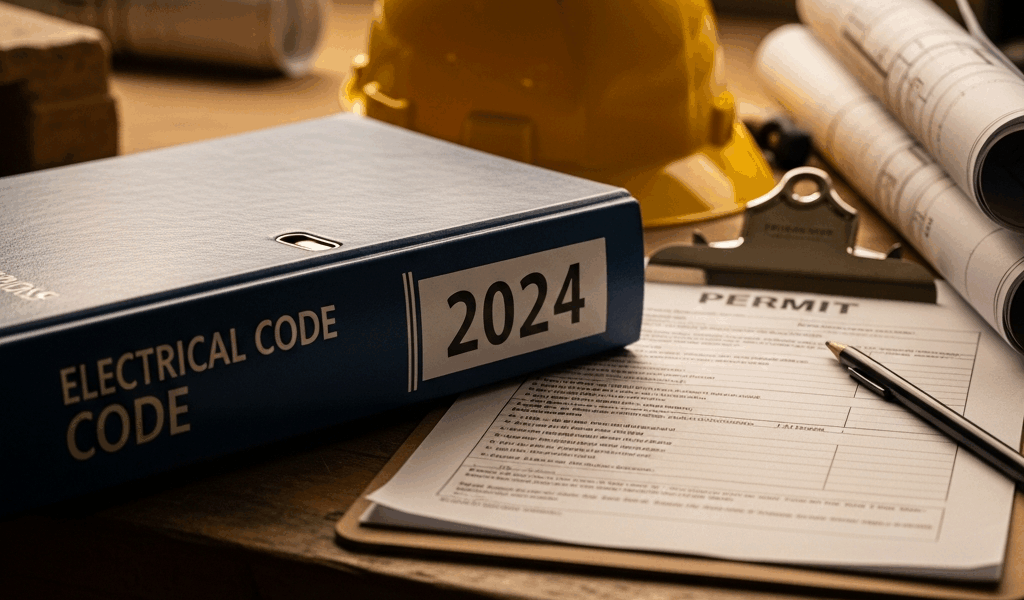
Which Electrical Code Harvey Is Enforcing Right Now
Electrical code compliance in Harvey has gotten complicated with all the misinformation flying around. Most contractors assume their city runs on the latest NEC edition. That assumption costs real money when an inspector red-tags your rough-in.
Here’s what’s actually happening: Harvey, Illinois enforces the 2020 National Electrical Code — adopted through Illinois state law, still in force as of 2024. The 2023 NEC exists. Harvey hasn’t moved to it. Illinois doesn’t auto-adopt new editions, and there’s often a legislative lag running two code cycles deep. That gap matters enormously on active permits.
I called the Harvey Building Department directly to confirm this. The answer was unambiguous: 2020 NEC, no local amendments deviating from state standard. Honestly, that last part is good news for contractors. No buried city-specific ordinances to hunt down. What the state adopted is what Harvey enforces. The effective date was 2022, which means we’re well into this cycle now. If your last Harvey job was in 2019, you’re working from an outdated rulebook.
Today, I will share everything I’ve learned about navigating it — permits, inspections, common fails, and how to stay ahead when the next cycle rolls around.
Key Code Changes That Affect Harvey Permits and Inspections
The 2020 NEC introduced changes that show up constantly on Harvey job sites. I’ve watched contractors fail rough-ins because they didn’t track what shifted. These are the ones that actually matter.
AFCI Protection Expanded
But what is AFCI expansion, really? In essence, it’s a broader mandate requiring arc-fault circuit interrupter protection on circuits that previously didn’t need it. But it’s much more than that — it’s a fundamental rethinking of which spaces carry fire risk.
Under the 2017 code, AFCIs were required on bedroom outlets and kitchen counter spaces. The 2020 edition pushed that requirement to virtually all 120-volt, single-phase circuits in residential units. That’s a wide net.
Real example: a kitchen remodel that passed inspection in 2018 with standard breakers won’t pass today. Every 120V circuit feeding that kitchen needs either an AFCI breaker or an AFCI outlet at the first point in the circuit. That’s not a paperwork technicality. It’s rewiring decisions — sometimes significant ones.
GFCI Placement Rules Tightened
Ground-fault circuit interrupter requirements expanded too. The 2020 NEC requires GFCI protection on all bathroom receptacles — not just the ones within 6 feet of a sink. Outdoor outlets, laundry areas, crawlspaces. All of them.
The old approach: drop one GFCI outlet near a sink, leave the rest of the circuit unprotected. That doesn’t fly anymore. Each outlet in a protected location needs individual protection, or the whole circuit needs a GFCI breaker at the panel. Homeowners usually don’t understand this distinction until the inspector marks it as a fail on the final walkthrough. Don’t make my mistake — brief your clients on this before the inspection, not after.
EV Charging Circuit Requirements
A Level 2 charger — 240V, the standard home installation — requires a dedicated 40-amp or 50-amp circuit depending on the unit. Wire gauge matters here. 10 AWG minimum for 40-amp circuits, 8 AWG for 50-amp. Many Harvey homeowners discovered this mid-project when the electrician had already quoted labor based on the wrong wire run. The 2020 NEC codified these requirements formally, which means inspectors are specifically checking for them now.
Service Panel Labeling
Circuit labeling got strict. Every breaker must be clearly labeled with the specific load it controls. Not “Bedroom” — “Bedroom 1 – Outlets.” Not “Kitchen” — “Kitchen – Counter Outlets Left Wall.” Inspectors in Harvey are catching vague and unlabeled panels at final inspection. It’s a quick fail and an embarrassing one, because it’s entirely preventable.
What Harvey Homeowners Need to Know Before Pulling a Permit
Probably should have opened with this section, honestly. The permit process is where code adoption becomes a real-world problem.
When you submit an electrical permit application to the Harvey Building Department, expect questions about AFCI and GFCI scope on your plans. Even a simple outlet replacement can trigger circuit-level compliance requirements under the 2020 NEC. If that circuit now needs AFCI protection and you haven’t accounted for it, the permit review will flag it — or worse, the inspector will catch it on site.
The Harvey Building Department sits at 15320 Lincoln Avenue, Harvey, IL 60426. Phone is (708) 331-3700. Hours run Monday through Friday, 8 a.m. to 4:30 p.m. Call before you design or bid. Seriously. A contractor I know skipped that call on a basement remodel — the AFCI requirements he missed added $1,200 in labor and materials he hadn’t quoted. The client wasn’t happy. He wasn’t happy. That 15-minute call would have cost nothing.
Existing homes don’t get retroactively updated to 2020 NEC standards across the board. That’s the good news. The catch: any remodel or alteration in Harvey must bring the affected circuits into compliance. Touch a kitchen circuit during your renovation, and it needs AFCI protection. That’s not negotiable, and it’s not optional.
For panel work specifically, the Building Department now requires updated one-line diagrams showing circuit labeling. Submit plans with vague labels and the permit review bounces it back. Add one to two weeks to your timeline if that happens — at least if you’re working against a contractor deadline with a client already breathing down your neck.
Common Violations Harvey Inspectors Are Flagging Under the New Code
I’ve compiled this from conversations with inspectors and electricians working Harvey jobs over the past year or so. These are the actual fails happening right now, not theoretical ones.
- Missing tamper-resistant receptacles in bathrooms. All bathroom outlets must be tamper-resistant under the 2020 NEC — that small internal mechanism blocking foreign objects from entering the slots. A TR outlet costs maybe $2–$3 more than a standard receptacle. Contractors miss it constantly anyway. Inspection fail, every time.
- Incorrect wire gauge on EV charging circuits. Homeowner buys a Tesla Wall Connector, which requires a 50-amp circuit. Electrician runs 10 AWG wire — undersized for the load. Should be 8 AWG. Inspector catches it at rough-in. Walls come open. The electrician eats the rework cost, or the argument about who eats it gets ugly.
- Unlabeled or illegibly labeled circuit breakers. A panel relabel job sounds straightforward until the inspector sees “Br 1” and “Br 2” written in marker on masking tape. Won’t pass. Labels must be permanent, printed, and specific enough that any unfamiliar person can identify the load without guessing.
- AFCI protection skipped on non-bedroom circuits. Contractor installs new outlets in a finished basement, assumes AFCI applies only to bedrooms. Under 2020 NEC, it’s required in the basement too. Red tag at final inspection. That’s what makes the expanded AFCI rules so frustrating for contractors trained on older editions — the scope changed significantly and the old muscle memory doesn’t serve you here.
How to Stay Current as Harvey Adopts Future Code Cycles
Illinois doesn’t auto-adopt new NEC editions. There’s always a lag — sometimes three to five years. Knowing where to watch is probably your biggest competitive advantage as a contractor or homeowner doing serious renovation work.
Monitor the Illinois General Assembly website for electrical code bill introductions. When a new NEC adoption bill moves through committee, you’ll see it there first. Illinois Building Commission notices are worth subscribing to as well — they publish adoption timelines when legislation advances. The Harvey city ordinance page updates when local code changes are formally adopted. Bookmark it. Check it quarterly.
I’m apparently obsessive about this, and IBEW Local 134’s public alerts work for me while informal word-of-mouth never does. Even if you’re not union, their code adoption updates are accurate and free. Worth ten minutes to find the right page and bookmark it.
My actual recommendation: call the Harvey Building Department six months before any major project. Ask which NEC edition is currently in force. Ask whether any adoption is pending. Don’t assume. Don’t guess based on what a colleague mentioned. One 15-minute phone call saves weeks of rework and the kind of client conversation nobody enjoys having.




Stay in the loop
Get the latest northwest electric pros updates delivered to your inbox.