“`html
Signs Your Ceiling Fan Is Overloaded
I’ve spent the last three years helping homeowners troubleshoot ceiling fan installations, and honestly, the weight limit question almost always arrives too late — usually after something has already gone sideways. You’re noticing the wobble. Maybe the light fixture won’t stay tight. Or worse, you smell something burning near the canopy.
Excessive wobbling is your earliest warning sign. Most people assume ceiling fans move a little. They shouldn’t. A properly installed fan with correct weight distribution barely vibrates at all. What you’re actually feeling is the junction box — the electrical box anchoring everything to your ceiling — starting to fail under load. The movement pattern tells you everything: side-to-side rocking means the mounting bracket is bending or the box itself is pulling away from the framing. Up-and-down bouncing points to loose mounting screws backing out because the vibration won’t quit.
Humming or buzzing under load is mechanical failure happening in real time. When you turn on the light fixture, the total electrical draw increases, and the vibration intensifies. That sound you’re hearing? It’s the motor and junction box resonating together at a frequency that shouldn’t exist if everything were secure. I made this mistake in my own kitchen install — figured it was normal fan noise. Turned out my Harbor Breeze 42-inch fan plus an 8-pound frosted glass fixture had created a harmonic frequency in the box mounting bracket. The screws were vibrating loose one-eighth turn per day.
The canopy pulling away from the ceiling is non-negotiable. That gap between the decorative canopy and your drywall means the box is bending downward under the weight. The mounting bracket is flexing like a diving board. Once this starts, it accelerates. Screw holes enlarge. The bracket warps further. Within weeks, you’re looking at electrical damage or a falling fixture.
Burning smell or scorch marks on the wiring inside the canopy indicate wire insulation is melting. This happens because vibration causes the wires to move against the junction box edges, fraying the insulation. Arcing follows. Then fire risk becomes real. Stop using the fixture immediately if you see discoloration on the wires or smell anything chemical near the ceiling.
Standard Weight Limits by Junction Box Type
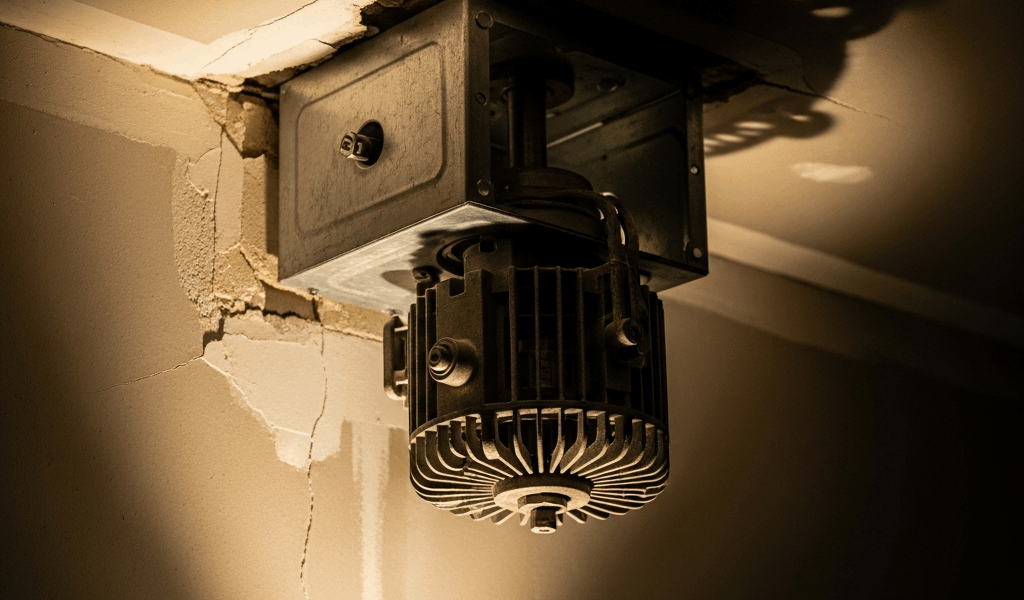
Your ceiling fan’s weight limit depends entirely on one thing: what kind of junction box is mounted in your ceiling. Most homeowners have never opened the canopy to look. That’s where the disconnect happens. You’re either working with a pancake box, a standard new-work box, or an old-work retrofit box. Each has a different rating because of how they’re anchored to your framing.
A pancake box is the smallest and weakest option. It’s flat, recessed directly into the drywall — sometimes only 1 to 2 inches deep. You’ll find these in older homes or quick renovations because they’re cheap and fit into tight spaces. Maximum safe load: 35 pounds. The limit exists because the screw threads anchoring the mounting bracket are short, the bracket material is thin gauge steel, and there’s minimal contact area with surrounding framing. The box itself is essentially glued to the drywall with small fasteners.
Standard new-work boxes are deeper — typically 2 to 3 inches — and mounted directly to ceiling joists during framing. These can handle 50 pounds because the mounting screws go into solid wood framing, the bracket is heavier gauge, and the box has more structural rigidity. Building code (NEC 314.27) actually specifies this rating for standard boxes used with light fixtures.
Old-work or retrofit boxes use toggle bolts or expansion wings to anchor into existing drywall without framing behind them. These max out around 40 pounds. The bolts distribute load across a wider drywall area, but the drywall itself is the weak point. It’s softer than wood, and the load capacity depends on whether your ceiling is standard drywall or reinforced.
Here’s the weight math most people skip. Take your fan motor weight — check the spec sheet; my Harbor Breeze 42-inch was 15 pounds — then add your light fixture weight. Typical frosted glass or crystal fixture runs 8 to 12 pounds. Add the bulbs and shades. That’s your total load. If you’re at 23 pounds total, a pancake box is marginal. At 35 pounds, you’re at the pancake limit and within the retrofit limit. At 50 pounds, you need a standard new-work box or the load is unsafe.
How to Check Your Junction Box Type
Turn off the breaker controlling the ceiling fan. Wait five minutes. Then remove the canopy — the decorative piece that covers the junction box.
A pancake box will look like a thin metal disc, barely recessed into the ceiling. It’s flat. You’ll see the mounting bracket attached with two or three short screws directly to the box. The bracket itself is thin and sometimes slightly bent if the fan has been running a while. Pancake boxes are usually stamped with a weight rating right on the metal — look for “35 lbs” or similar markings.
Standard boxes are deeper and more box-like. You’ll see a rectangular or octagonal metal housing that extends back into the ceiling cavity. The mounting bracket bolts to ears on the side or bottom of the box. These feel more substantial. They often have visible inspection marks or code numbers stamped on them.
Old-work boxes have toggle bolts or spring wings visible on the sides. Instead of attaching to framing, the bolts spread inside the drywall cavity. If you see metal wings or toggle hardware, that’s an old-work box.
If you genuinely can’t identify the box — maybe the canopy is stuck, or the box is buried under insulation — assume 35 pounds maximum and call an electrician. Don’t guess on electrical load calculations.
What Happens If You Exceed the Weight Limit
This needs to be direct: overloading a ceiling fan junction box will cause failure. It’s not a possibility. It will happen.
The sequence is mechanical first, then electrical. Excess vibration causes mounting screws to loosen. Loose screws create micro-movements. Those movements cause the wiring to shift inside the junction box, fraying insulation. Frayed insulation means bare copper. Bare copper creates arcing when power flows. Arcing generates heat — enough to melt plastic wire connectors and ignite insulation.
The fire hazard is real. The National Electrical Code (NEC 314.27, reaffirmed in the 2023 edition) specifies these weight limits because inspectors and engineers have seen exactly what happens when they’re exceeded. Overheated junctions in walls and ceilings burn from the inside out, hidden from view, until smoke appears or a wall catches fire.
Beyond fire, the mechanical failure is obvious. Fans fall. Light fixtures disconnect. Wiring gets damaged beyond repair. You’re looking at drywall patching, possible wall damage from the fall, and a rerun of electrical to that location.
Most homeowners exceed limits because the fixture “seems light” or “worked fine for two years so far.” Weight feels subjective. A 12-pound glass fixture doesn’t feel heavy when you hold it. But mounted to a pancake box and vibrating 50 times per second as the fan runs, that weight becomes dynamic load. Physics doesn’t care about intuition.
When to Replace Your Junction Box
If you’ve identified overload signs — wobbling, humming, canopy gap — and your total fixture weight exceeds the box limit, upgrading the box is your move.
Upgrading means removing the old pancake or retrofit box and installing a standard new-work box rated for 50 pounds. This requires cutting into drywall, running new electrical if the existing wire isn’t properly secured, and patching the ceiling. Professional installation runs $150 to $300 in labor. The box itself costs $20 to $40. It’s a two-to-three-hour job for an electrician.
The alternative: swap to a lighter fixture or split the load. If your total is 45 pounds and you need to stay under 50, replace a 10-pound crystal fixture with a 5-pound frosted glass one. Or install the light fixture separately on its own circuit with its own pancake box, keeping the fan on a separate box.
For loads over 60 pounds, upgrading a single box won’t solve it. Use two separate fixtures, each on its own circuit and junction box. That’s the only safe path.
“`




Stay in the loop
Get the latest northwest electric pros updates delivered to your inbox.