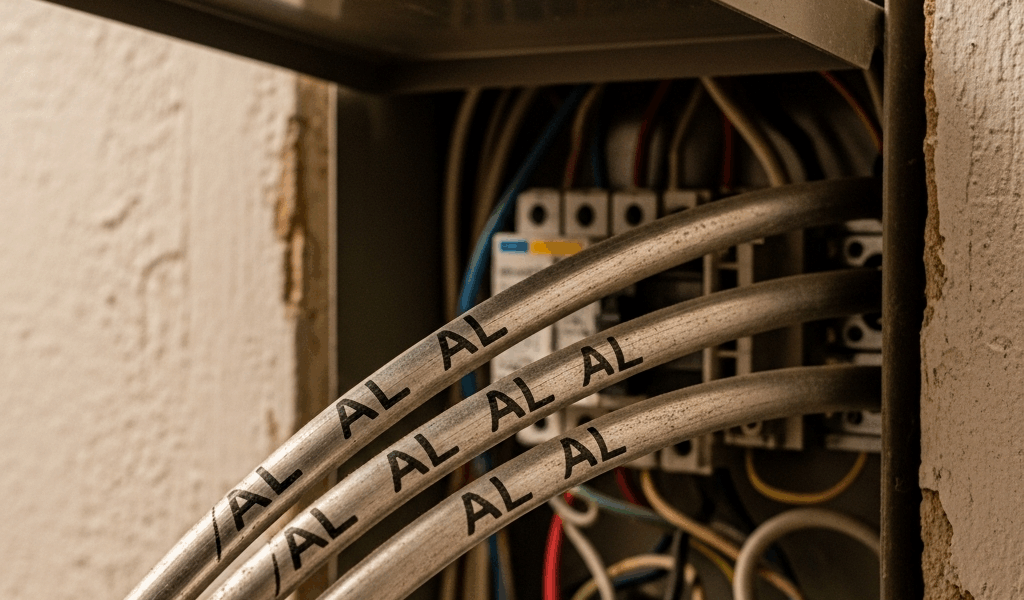
Your home inspector just flagged aluminum wiring. Or you found “AL” printed on the cable sheathing inside your panel. Either way, you need to know what you are dealing with. The wire itself is not the problem — the connections are. Here is what aluminum wiring means for your home, your insurance, and your options.
What Is Wrong with Aluminum Wiring
Single-strand aluminum branch circuit wiring was installed in homes between 1965 and 1973, during a period when copper prices spiked. Aluminum conducts electricity well, but it expands and contracts more than copper when heated. Over time, the connections at outlets, switches, and fixtures loosen. Loose connections create arcing. Arcing creates heat. Heat creates fire risk.
The Consumer Product Safety Commission identified this issue in the 1970s and estimated that homes with single-strand aluminum wiring are 55 times more likely to have fire hazard conditions at connections than homes wired with copper. That number is not about the wire in the wall — it is about what happens at every outlet, switch, and junction box where the aluminum meets a connection point.
Important distinction: multi-strand aluminum wire used for service entrance cables and large appliance circuits is normal and safe in modern installations. The concern is specifically single-strand aluminum on 15 and 20 amp branch circuits — the wiring that runs to your outlets and light switches.
How to Identify Aluminum Wiring in Your Home
Look at the wire jacket where cables enter your electrical panel. Aluminum circuit wiring has “AL” or “ALUM” printed on the cable sheathing. Copper wiring is marked “CU” or has no conductor marking.
If you are not comfortable opening the panel cover, hire a licensed electrician for a home electrical inspection. Most electricians will identify aluminum wiring within the first 5 minutes of an inspection.
Not every older home has aluminum wiring. It was primarily used between 1965 and 1973. Homes built outside this window are unlikely to have single-strand aluminum branch circuit wiring. If your home was built in 1960 or 1980, aluminum wiring is unlikely unless the home was rewired or expanded during the 1965-1973 window.
How Aluminum Wiring Affects Homeowners Insurance
Many insurance carriers will not write new policies for homes with unrepaired aluminum wiring, or they will charge significantly higher premiums. State Farm, Allstate, and other major carriers vary their requirements by state, but the trend is consistent: aluminum wiring is a known risk factor that affects underwriting.
Some carriers require a licensed electrician’s inspection letter confirming the wiring is in safe condition or has been professionally remediated before they will issue a policy. Others will issue the policy but exclude electrical fire coverage.
If you are buying a home with aluminum wiring, check your insurance carrier’s requirements before closing. Discovering that your preferred carrier will not insure the home — or requires a $3,000 repair before coverage starts — is better to learn during due diligence than after closing.
Repair Options: Full Rewire vs AlumiConn Connectors
Full copper rewire: Complete replacement of all aluminum branch circuit wiring with copper. Cost: $8,000 to $15,000 for a typical 3-bedroom home. Requires opening walls, which means drywall repair and paint. Eliminates the aluminum wiring issue permanently. This is the gold standard but the most expensive and disruptive option.
AlumiConn connectors: Approved by the CPSC and UL-listed. A copper pigtail is connected to each aluminum wire at every outlet, switch, and fixture using a set-screw lug connector. The copper pigtail then connects to the device. Cost: $1,000 to $3,000 depending on the number of outlets and fixtures. No wall opening required. This is the most cost-effective permanent repair and the one most electricians recommend for homeowners who want the problem solved without tearing open the house.
CO/ALR-rated devices: Outlets and switches specifically rated for aluminum connections. Lower cost than AlumiConn but does not address all connection points — only the device terminations. Some inspectors and insurance companies accept CO/ALR devices; others require AlumiConn or full rewire.
What to Do Before Selling a Home with Aluminum Wiring
Most states require disclosure of known material defects, and aluminum wiring typically qualifies. Buyers and their inspectors will find it — it is one of the first things a competent home inspector checks in a 1960s or 1970s home.
Proactive approach: get the AlumiConn repair done before listing. Provide the buyer with the licensed electrician’s inspection letter and the repair documentation. A $2,000 to $3,000 AlumiConn repair is a much smaller number than the $10,000 price reduction a buyer will negotiate at inspection when they discover unrepaired aluminum wiring.
The repair pays for itself in the transaction. Homes with documented aluminum wiring remediation sell faster and with fewer inspection-related re-negotiations than homes where the buyer discovers the issue during due diligence.

Stay in the loop
Get the latest northwest electric pros updates delivered to your inbox.