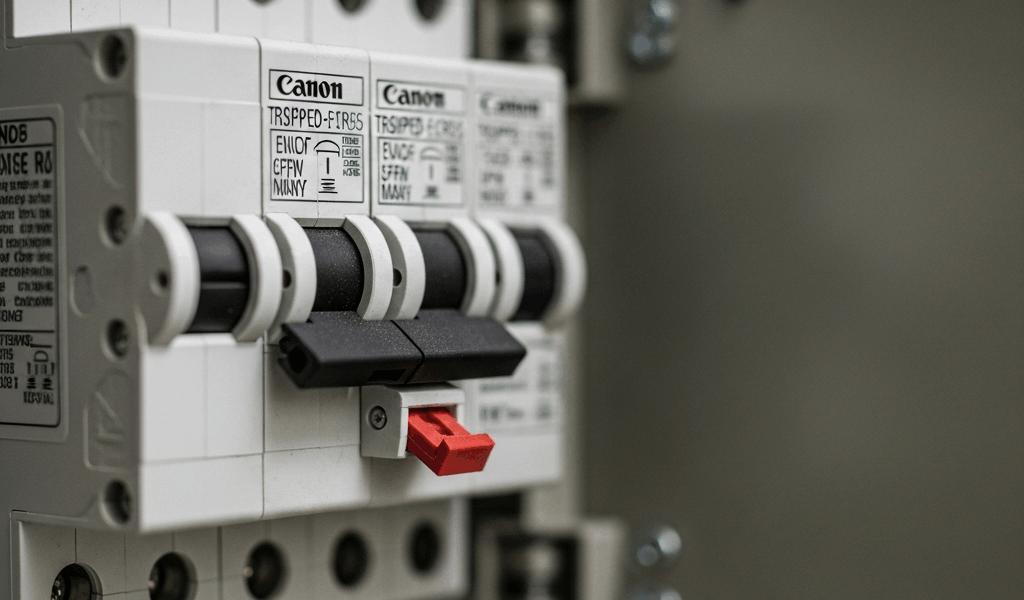
The Most Likely Culprit Is the Breaker Itself
Tripping breakers have become tricky with all the conflicting advice flying around. Everyone assumes it’s the wiring, the moisture, some elaborate fault deep inside the walls. But here’s what I’ve seen again and again: it’s the breaker. The breaker itself. Not the circuit. Not rodents. The $12 part.
I watched a homeowner spend $800 on a licensed electrician — new wiring, the whole diagnostic workup — only to find out the breaker had simply worn out. That was a Tuesday in November. The replacement part cost $14 at Home Depot. A worn-out breaker is the single most common cause of spontaneous tripping, and catching it first saves you a lot of money and frustration.
But what is breaker fatigue, exactly? In essence, it’s the internal bimetallic strip — or electronic sensor, depending on the model — degrading past its useful threshold. But it’s much more than just old age. After 15 to 20 years, that strip can trip at half the rated amperage or cut out spontaneously with zero load on the circuit. Square D QO breakers, Eaton BR series, Siemens QP — the brands you’ll find in most Pacific Northwest panels — all wear out eventually. The older the panel, the more likely the breaker is your answer.
Test it right now. Reset the breaker fully — flip it all the way off, then back on. Leave the circuit dead. Nothing plugged in. No fixtures. No switches. Watch it for 30 to 60 minutes. If it trips again with absolutely nothing connected, that’s your answer. The breaker is bad.
Replacement breakers run $8 to $25 at Home Depot or Lowe’s. But here’s the catch — and I mean this — you cannot safely install one yourself unless you hold an electrical license. Working inside a main panel means de-energizing the main breaker, and most jurisdictions in Washington and Oregon require a licensed electrician and a permit for any panel work beyond a simple reset. That’s consumer protection, not a scare tactic. A licensed electrician will run $200 to $400 with labor to diagnose and swap the breaker. Worth every cent.
Ground Faults in the Wiring Can Trip a Breaker With No Load
A damaged wire can absolutely trip your breaker with nothing plugged in. Full stop.
Rodents chew through insulation in attics and crawlspaces — especially between October and April when cold weather drives them inside. Nails and screws puncture wires during renovations. Insulation breaks down from heat and age. Any of these creates a ground fault — current escaping the conductor and finding a path to ground. A standard breaker won’t catch this. An AFCI or GFCI breaker will. That’s the entire point of their existence.
This is where most articles drop the ball. They describe ground faults without telling you what type of breaker you actually have. Look at your breaker right now. Does it have a small button labeled “TEST” on the face? That’s a GFCI or AFCI breaker. It’s built to detect wiring faults, not just overloads. If you have one and it keeps tripping with nothing connected, the wiring is your suspect — not the breaker itself. That distinction matters enormously for what comes next.
Here’s the practical test: walk the entire circuit. Check every outlet, switch, and junction box for burning, discoloration, scorch marks, or moisture. Pull off cover plates. Look inside outlet boxes if you can safely do so. Rodent droppings. Chewed insulation. Wet spots. Anything that doesn’t belong.
The Pacific Northwest makes this worse, honestly. Attic and crawlspace wiring takes the most damage here — moisture encourages rodent activity, and cold winters push them straight into your walls. Between October and April, rodent-related wire damage in attics goes up dramatically in this region.
Find damage? Suspect damage? Stop. Call a licensed electrician. A hard short or arc fault inside a wall is not something you poke at hoping it resolves itself.
How to Confirm the Circuit Is Actually Clear Before Diagnosing
Important part first. I learned this the hard way — wasted nearly two hours diagnosing a “dead” circuit that was still drawing power from three hardwired fixtures I’d completely forgotten about.
When you flip a breaker, you assume everything on that circuit goes dark. It doesn’t. Hardwired devices stay connected — recessed lights, in-wall heaters, bathroom exhaust fans, smoke detectors, electric water heater elements. None of those are plugged into outlets. They’re wired directly into the circuit and they stay live regardless of what you unplug from the wall.
Before blaming the breaker or the wiring, confirm the circuit is genuinely clear. Here’s how:
- Check your breaker panel directory — that label inside the panel door listing which breaker controls which rooms. If it’s wrong or incomplete (and most panels I’ve seen have at least three inaccurate labels), grab a non-contact voltage tester. Flip the breaker off. Test every outlet and light switch in the suspected area. Any outlet still showing voltage belongs to a different circuit.
- Walk the circuit methodically. List every outlet, switch, fixture, and hardwired device. Bathroom exhaust fans are the sneaky ones. So are hallway motion-sensor lights and smart thermostats — those draw power in standby mode around the clock.
- Flip the breaker back on. Use the voltage tester to confirm power at the outlets. This verifies the breaker actually controls what you think it does — not always a safe assumption in older homes.
- Now flip it back off and leave it off while you continue testing.
A non-contact voltage tester runs $12 to $30. I’m apparently a Klein Tools person — the MM400 works for me while the cheap no-name testers I’ve tried never gave consistent readings. Avoid the path I took. Buy a name brand once and move on.
Moisture or a Tripped GFCI Outlet Elsewhere on the Circuit
Here’s a scenario most homeowners never think about: a GFCI outlet somewhere else on the circuit has already tripped — and it’s cutting power to everything downstream from it.
Many circuits run outlets in series. One feeds the next. If a GFCI outlet trips from a minor ground fault or moisture intrusion, it can kill power to every outlet after it on that same circuit. Your main breaker might not trip at all, but you’ll still have dead outlets. In some wiring configurations, though, the main breaker trips too — which is exactly how you end up confused about why a “dead” circuit keeps misbehaving.
Before calling anyone, reset every GFCI outlet on the affected circuit. Bathrooms. Kitchen. Garage. Outdoor outlets. Press the RESET button on each one. If the breaker stops tripping after that — you found it. The GFCI outlet caught a fault and did exactly what it was designed to do.
But if the breaker keeps tripping and every GFCI outlet is already reset, look at moisture next. Outdoor outlets in the Pacific Northwest collect condensation year-round — basically October through May here is wet season, no exceptions. Garage outlets get splashed. Crawlspace junction boxes soak up humidity for months at a time. Moisture inside an electrical box can trip a breaker with nothing plugged in at all.
The tell: the breaker resets fine, then trips again after rain or during a stretch of humid weather. That’s moisture in a box or outlet. That requires a licensed electrician to locate and seal properly.
When to Stop Testing and Call an Electrician
If the breaker trips immediately upon reset — no load, circuit confirmed clear — stop. Don’t reset it again. That pattern points to either a hard short in the wiring or a panel-level problem. Neither of those gets better with more resets.
Call now if you notice any of these: a burning smell from the panel, a breaker that’s warm or hot to the touch, a breaker that won’t reset at all, or multiple breakers tripping at the same time. These are fire hazards. Not inconveniences. Hazards.
In Washington and Oregon, panel work requires a licensed electrician and permit — full stop. That’s code, not gatekeeping. A diagnostic service call runs $150 to $300. Breaker replacement with labor lands between $200 and $400. Budget for that before you pick up the phone, and you’ll have a much smoother conversation.
Don’t guess. Don’t experiment. Call.



Stay in the loop
Get the latest northwest electric pros updates delivered to your inbox.