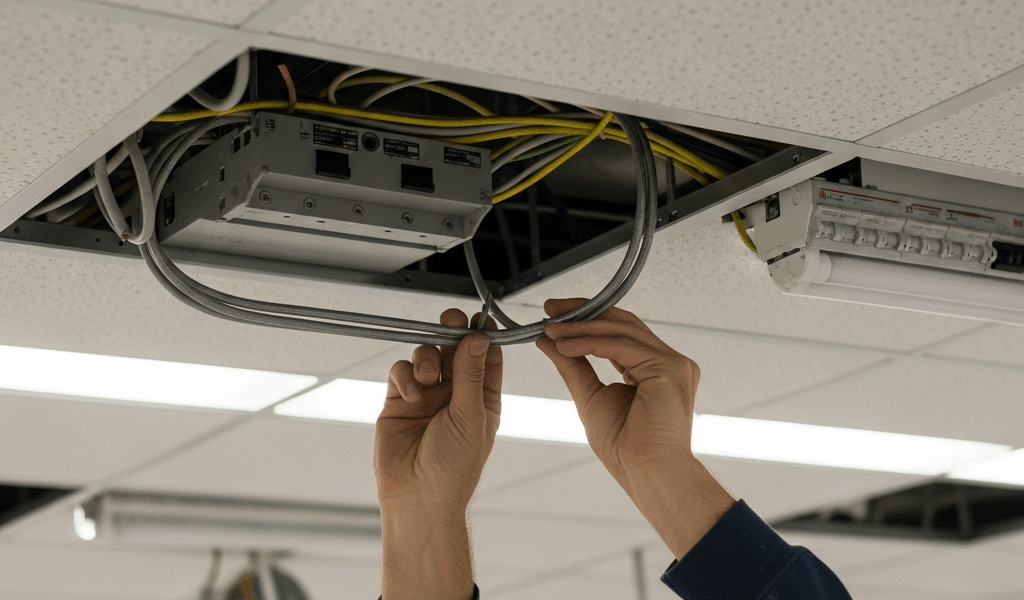
Commercial office electrical installation cost cannot be estimated responsibly from square footage alone. The useful method is to define the same scope for every bidder, count the actual devices and circuits, document existing conditions, separate allowances from fixed work, and price permitting, inspection and closeout explicitly.
This guide does not publish a national “cost per square foot” because labor markets, permit fees, building access and project requirements vary. It shows what belongs in a quote and how to compare bids without creating false precision.
What drives office electrical cost
| Cost driver | Why it changes price | Evidence to request |
|---|---|---|
| Existing service and panels | Capacity, condition, breaker availability and access affect design and labor | Survey, photos, load calculation, panel schedules |
| Circuit and device count | Each run has routing, conductor, raceway, termination and testing work | Device/circuit schedule and marked plan |
| Building access | Finished walls, concrete, occupied floors and long pathways add labor | Site walk and routing assumptions |
| Lighting and controls | Fixture reuse, controls, emergency work and commissioning vary | Fixture/control schedule and sequence |
| Permits and inspections | Fees and plan-review requirements are jurisdiction-specific | Named authority, fee basis and permit responsibility |
| Schedule and phasing | Night work, shutdowns and fast-track sequencing add coordination | Milestones, outage plan and working hours |
Start with a bid-ready scope
Give every contractor the same floor plan and equipment information. Mark workstation locations, conference rooms, printers, kitchen equipment, server or telecom spaces, reception, storage, signage and any future expansion. Identify whether the office is occupied and which surfaces may be opened.
A useful request for proposal should state:
- number and type of receptacles, floor boxes and equipment connections;
- known dedicated-circuit or manufacturer requirements;
- lighting fixtures, controls and emergency scope;
- data pathways and whether cabling is included;
- panel, feeder or service work included or excluded;
- permit, inspection, utility and plan-review responsibilities;
- patching, painting, ceiling work and firestopping responsibility;
- normal work hours, shutdown windows and occupancy constraints; and
- testing, labeling, warranties and closeout documents.
Separate base scope, options and allowances
A single lump sum can hide major differences. Ask bidders to separate:
- Base electrical work: defined circuits, devices, panels, lighting and controls.
- Existing-condition corrections: work that is known versus discovered after opening walls.
- Alternates: optional UPS, generator, additional capacity, premium fixtures or future pathways.
- Allowances: undecided fixtures or uncertain utility work, with unit prices and markup rules.
- Excluded work: data cabling, fire alarm, security, furniture feeds, drywall, painting or engineering if not included.
An allowance is not a guaranteed final price. Require a written change-order process and documentation before allowance overruns or extra work proceed.
Why service and panel assumptions matter
Do not assume an older office needs a service upgrade, and do not assume an empty breaker space proves usable capacity. A qualified assessment should consider calculated loads, ratings, breaker compatibility, conductor condition, available fault current where applicable, working clearances and planned equipment.
If the utility, service, feeder or panel scope is uncertain, price investigation first or make the assumption explicit. “Existing panel adequate” without supporting information can turn into a large change order.
Permit and inspection costs are local
Permit fees may depend on jurisdiction, service size, circuits, devices, project valuation or other schedules. Washington L&I publishes an online permit system and current fee logic, while certain cities and Tacoma Power use their own programs. A national fee range is therefore misleading.
Require the quote to name the permitting authority, identify who purchases the permit, and include expected inspections. Washington L&I says hired electrical contractors must purchase their own permits and that work must remain visible for required inspection. Confirm the rules where the office is located.
Low bid versus complete bid
Normalize bids line by line before comparing totals. A lower proposal may omit engineering, permits, demolition, firestopping, controls programming, lift rental, after-hours labor, utility coordination, testing or patching.
Ask each bidder to confirm:
- contractor license and the classification covering the work;
- bonding and insurance required by the project or jurisdiction;
- permit and inspection responsibility;
- specific equipment and fixture allowances;
- labor rates and markup rules for authorized changes;
- schedule, shutdowns and access assumptions;
- warranty terms and exclusions; and
- as-built drawings, panel directories and test documentation.
Washington L&I provides a contractor-verification process and advises owners to confirm licensing and certification. Use the responsible licensing authority for the project’s state or locality rather than relying on an advertisement.
How to reduce cost without reducing safety
- Freeze the workstation and equipment plan before rough-in.
- Schedule one thorough site walk for all bidders.
- Coordinate electrical, furniture, mechanical, ceiling and data drawings.
- Choose accessible pathways where the design permits them.
- Bundle planned work to avoid repeated mobilization and ceiling access.
- Schedule required shutdowns early with building management and occupants.
- Use alternates to compare future capacity or premium features transparently.
- Do not hide work before inspection or use unlicensed labor to chase a lower number.
Office electrical budget worksheet
- Survey existing service, panels and pathways.
- Count devices, circuits, equipment connections and lighting/control points.
- Price permitting, design, utility and inspection work.
- List access, phasing, shutdown and restoration costs.
- Separate data, fire alarm, security and furniture power.
- Add documented contingency appropriate to remaining unknowns.
- Compare exclusions and unit prices, not only the total.
For the design and compliance scope behind those line items, read the commercial office electrical requirements guide. For a dwelling workspace, use the separate home-office wiring guide.
Frequently asked questions
What is the average cost to wire an office?
There is no dependable national average for a specific project. Existing conditions, device and circuit counts, access, permitting, lighting, controls and schedule can outweigh square footage. Obtain comparable local bids from a defined scope.
Does the electrician’s quote include permits?
Only if the proposal says so. Require permit fees, plan review, inspection and correction responsibility to be explicit. Local law may dictate who must purchase the permit.
Is data cabling included in electrical installation?
Not automatically. Define pathways, cable, terminations, testing and labeling separately even if one contractor supplies both.
Should an office budget for a service upgrade?
Only when a qualified assessment supports it. Budget investigation where capacity is uncertain rather than assuming an upgrade is always or never needed.




Stay in the loop
Get the latest northwest electric pros updates delivered to your inbox.