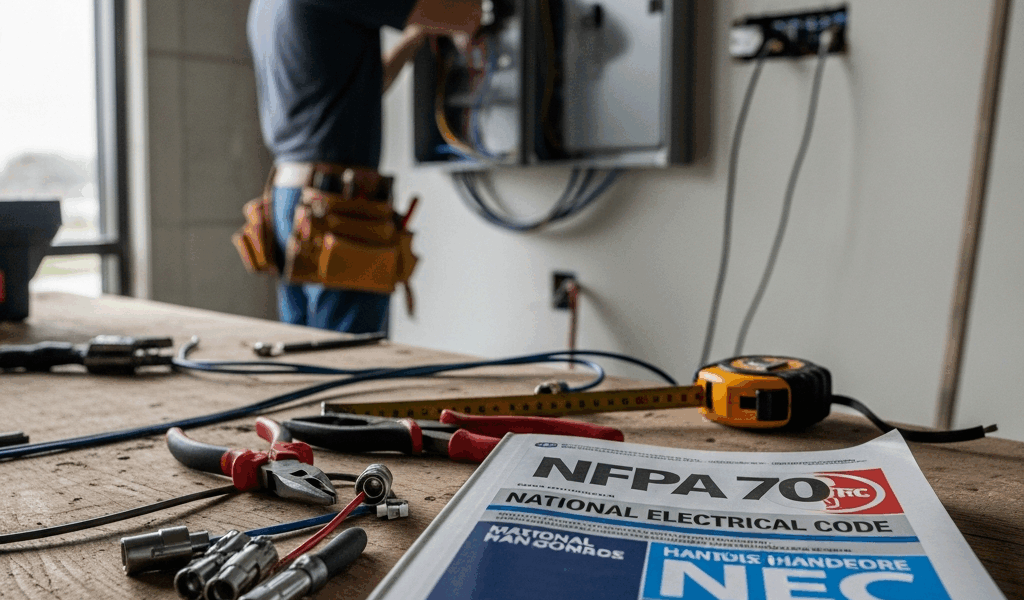
Commercial office electrical installation is a coordinated design, permitting, inspection and commissioning project—not a universal outlet-spacing recipe. The correct requirements depend on the locally adopted electrical and building codes, occupancy, tenant layout, equipment loads, emergency systems, accessibility rules, energy code, lease conditions and the authority having jurisdiction (AHJ).
This independent guide helps an owner or tenant prepare a scope. It does not replace engineered documents, the adopted code or a licensed electrical contractor. Do not work on energized equipment or assume an article can approve a design.
Commercial office electrical scope at a glance
| Workstream | Questions to resolve | Typical evidence |
|---|---|---|
| Existing service and panels | Is capacity available? Are equipment ratings and working clearances suitable? | Field survey, panel schedules, load calculations |
| Branch circuits and receptacles | Where are workstations and fixed loads? Which equipment has manufacturer supply requirements? | Power plan, equipment schedule, circuit schedule |
| Lighting and controls | What illumination, switching, emergency and energy-code controls apply? | Lighting plan, photometrics, control narrative |
| Data and low voltage | How many drops, pathways, telecom rooms and future connections are needed? | Technology plan, cable/pathway specification |
| Permits and inspection | Which agency has jurisdiction and when must work remain exposed? | Permit record, approved plans, inspection results |
1. Confirm the jurisdiction and adopted code first
The National Electrical Code is adopted and amended by states and local jurisdictions; a project must follow the edition and amendments in force at its location. Other requirements can come from building, fire, accessibility and energy codes, utility standards and the lease. Ask the permitting agency which rules apply before drawings and bids are finalized.
Washington L&I states that electrical work generally requires a permit and inspection, while some cities and Tacoma Power administer their own programs. It also states that Washington inspections currently use the 2023 NEC. That is useful for a Washington project, but it is not a nationwide rule.
2. Survey existing power before promising new circuits
A panel’s labeled service size does not prove capacity for a tenant improvement. A qualified designer or contractor should document the service, feeders, panels, breaker compatibility, conductor condition, grounding and bonding, available spaces, working clearances and existing loads. Planned HVAC, kitchen, server, copier, laboratory or EV loads must be included where applicable.
Do not use “80% full” as an automatic trigger for a service upgrade. Continuous-load treatment and load calculations have specific code rules. A proper assessment may support a new circuit, feeder, panel, load-management strategy or service change; the answer depends on the actual installation.
3. Design around the real workstation and equipment plan
General commercial offices do not inherit the dwelling-unit wall-receptacle spacing rule merely because desks sit against walls. Receptacle quantity and placement should follow the adopted rules plus the furniture, circulation and equipment plan. Floor boxes, furniture feeds or power poles may serve open offices, but their listing, use, accessibility and coordination must be verified.
Build an equipment schedule from manufacturer nameplates and installation instructions. Identify computers, monitors, printers, copiers, kitchen appliances, water dispensers, AV systems, server equipment and any fixed machinery. A dedicated circuit should be based on calculated load or equipment instructions—not a generic claim that every two or three desks need one circuit.
4. Apply protection requirements by location and use
GFCI, AFCI and other protective requirements vary by adopted code edition, occupancy, voltage, location and equipment. A receptacle near a sink, outdoors, on a rooftop or in another specified location may be treated differently from a dry workstation receptacle. Do not add or omit protection from a simplified blog checklist.
OSHA’s general-industry electrical standards cover workplace electrical safety, including installation and use, wiring design and protection, equipment grounding and working space. OSHA also notes that state-plan programs may impose different or more stringent requirements. The design must satisfy both installation requirements and safe workplace use.
5. Coordinate lighting, controls and emergency systems
Lighting design must account for the actual office layout, task needs, egress, energy-code controls and emergency requirements. Do not assume one voltage, one circuit count or one emergency-lighting architecture fits every building. Emergency and legally required systems need design by qualified professionals using the applicable building, fire, life-safety and electrical requirements.
Document control zones, occupancy or vacancy sensors, daylight response where applicable, after-hours operation and commissioning. Moving partitions after design can affect both normal lighting and egress coverage.
6. Treat data pathways as a coordinated system
Power and communications wiring have different permitted wiring methods and separation rules. Requirements depend on cable type, raceway, barriers, listing, environment and adopted code. Avoid repeating a universal “two-inch separation” rule: electromagnetic-compatibility design guidance and electrical-code separation are not interchangeable.
Plan telecom-room location, rack power, UPS strategy, grounding/bonding, pathways, firestopping, plenum requirements, cable counts and growth capacity. Verify who supplies and tests each part. A low-voltage allowance without a drop count, test standard and labeling requirement is not a complete scope.
7. Permit and inspect the work in the correct sequence
Identify who prepares drawings, purchases permits, coordinates utility work, schedules inspections and closes corrections. Washington L&I says a hired electrical contractor must purchase its own permit and that concealed work must be inspected before covering. Other jurisdictions have their own processes and timelines.
Avoid promising a fixed inspection turnaround. Schedule framing, ceilings and move-in with contingency for review comments, rough inspection, corrections and final approval.
Commercial office electrical planning checklist
- Confirm AHJ, adopted code editions and local amendments.
- Survey service, panels, feeders, grounding/bonding and existing loads.
- Freeze a furniture and equipment plan before circuit layout.
- List manufacturer electrical requirements for major equipment.
- Coordinate normal power, lighting, controls, emergency systems and low voltage.
- Define permits, plan review, inspections and utility responsibilities.
- Require panel schedules, labels, test results, warranties and closeout documents.
- Verify contractor licensing with the responsible state or local agency.
For budgeting and bid normalization, use our commercial office electrical cost guide. If the project is a dwelling workspace rather than a commercial tenant improvement, see the separate home-office wiring guide.
Frequently asked questions
How many receptacles does a commercial office need?
There is no reliable universal number per desk or wall length. The adopted rules, layout, equipment and future flexibility determine the design.
Does every office computer need a dedicated circuit?
No. Circuit design depends on actual simultaneous loads, equipment instructions and the adopted code. High-demand or business-critical equipment may justify separate circuits.
Can a business owner pull the electrical permit?
Rules vary. In Washington, L&I distinguishes property/business-owner work from work performed by a hired contractor; a hired contractor must obtain its own permit. Confirm the exact project and jurisdiction.
Can office electrical work happen while employees are present?
That requires a site-specific safety and phasing plan. OSHA electrical requirements, shutdowns, barriers, access, dust/noise and egress all matter. Qualified parties should plan the work.



Stay in the loop
Get the latest northwest electric pros updates delivered to your inbox.