Can I Install a Ceiling Fan Where a Light Fixture Is? What Electricians Check
The Short Answer — Yes, If the Box Is Fan-Rated
Ceiling fan installation has gotten messy with all the conflicting DIY advice flying around. As someone who spent several years doing residential electrical work before shifting into inspection and consulting, I spent months getting comfortable with what actually determines whether this swap goes smoothly or ends with a fan wobbling loose from your ceiling at 2 a.m.
Here’s the thing nobody leads with: the wire gauge, the voltage, the breaker size — none of that is your deciding factor. It’s the electrical box sitting in your ceiling right now. Everything else is secondary.
But what is a fan-rated box? In essence, it’s a mounting enclosure built to handle both static weight and the rotational torque a spinning motor produces. But it’s much more than that — it’s the difference between a fan that runs safely for decades and one that slowly works itself free from your ceiling.
A standard light fixture box handles 50 lbs of static weight — a chandelier that just hangs there, motionless. A ceiling fan is a completely different animal. It has a motor, spinning blades, and a constant rotational torque load working against every screw and fastening point in that box. A fan-rated box must support 35 lbs of hanging weight AND resist that dynamic torque load at the same time. Standard boxes can’t do both.
I’ve seen fans installed in standard boxes start pulling free from the ceiling within 18 months. One had a visible gap between the canopy and the ceiling by the time the homeowner finally called. The fan had been working — technically — the entire time. Don’t skip the box check.
How to Tell If Your Existing Box Is Fan-Rated
The piece that matters most here — because the answer is simpler than most people expect.
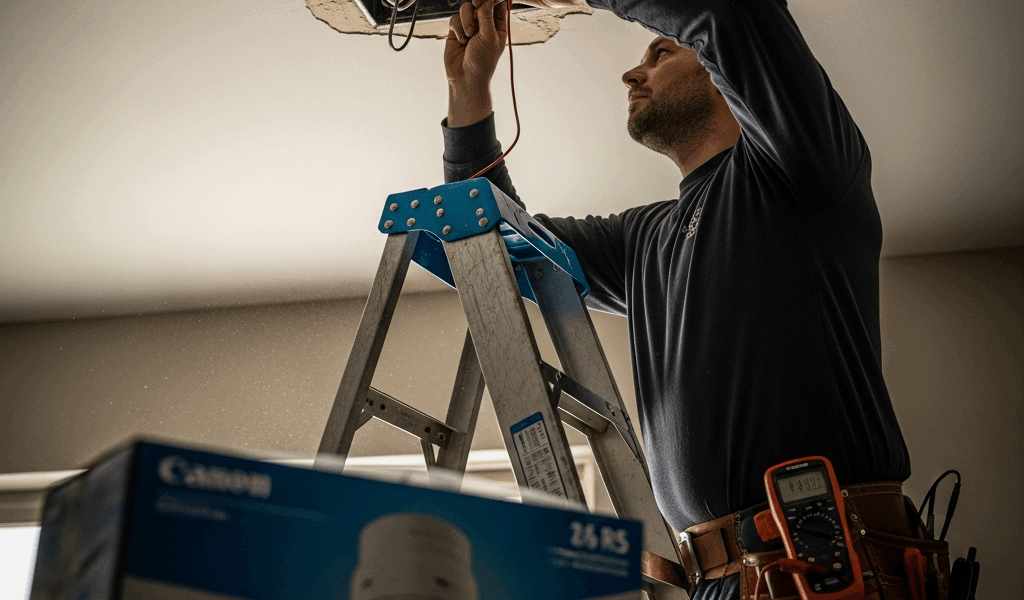
Turn off the breaker. Confirm the power is dead with a non-contact voltage tester — I use a Klein Tools NCVT-3P, about $30 at any home center. Remove the light fixture. Now look directly at the box housing.
Fan-rated boxes have specific language stamped or molded right into them. You’re looking for “Acceptable for Fan Support” or “Fan Rated” alongside a UL listing mark. That’s the entire check. If the box says it, you’re cleared. If it doesn’t, you’re not.
Here’s a rough field guide for what you might find up there:
- Round plastic boxes, pre-1993 vintage — Almost never fan-rated. Older plastic box? Assume it’s not rated and replace it. Don’t guess.
- Octagon metal boxes nailed directly to a joist — Some are fan-rated, some aren’t. Look for the UL marking. No marking means no fan.
- Cross-brace or pancake boxes — Mount directly against the joist or beam. Many are fan-rated, but check for the stamp regardless.
- Expandable bar hanger boxes (the kind that fit between joists) — These are what most electricians install for new fan locations. The Westinghouse 0101800 and the Hubbell RACO 294 are both fan-rated models. Still check the box itself for confirmation.
When there’s any question at all — replace the box. A fan-rated remodel brace kit, something like the King Innovation FanMATE or the Westinghouse 0101800 adjustable bar hanger, runs $15 to $30 at Home Depot or Lowe’s. It installs through the existing ceiling hole without cutting drywall. You expand the bar between joists, lock it down, and you have a code-compliant fan mounting point. I’ve installed probably 40 of these over the years — takes about 20 minutes once the old fixture is down.
That’s what makes the remodel brace endearing to us electricians. No drywall damage, no mess, no callbacks.
Weight and Load Ratings — What Fan-Rated Actually Means
The 35-lb static rating trips people up, and I get why. A standard 52-inch Hunter Original — one of the most common residential fans sold — weighs around 25 lbs with blades attached. A Harbor Breeze Mazon 44-inch comes in closer to 18 lbs. So the fan is well under the limit. Why does any of this matter?
Static weight is only half the story. The dynamic torque load — the rotational force the spinning motor exerts against the mounting hardware — is what separates fan-rated boxes from everything else. A non-rated box might physically hold 50 lbs of chandelier without moving a millimeter. Put a 22-lb ceiling fan on it, and months of constant vibration and torque will work those fasteners loose. The box rating isn’t just a weight number. It’s a measure of mechanical resistance to that spinning load specifically.
For most homes, a standard fan-rated box handles the job without any drama. Where it gets more specific: fans over 35 lbs — which typically means large-diameter fans in the 60-inch to 72-inch range designed for great rooms or commercial spaces. A 72-inch Monte Carlo fan can exceed 50 lbs with the blade assembly. For those, you need a box rated for that fan’s actual weight. The fan’s installation manual will state the required box rating clearly. Don’t assume the standard fan-rated box covers every fan on the market.
Most residential fans under 54 inches fall comfortably within standard fan-rated box capacity. Standard bedroom, standard living room, fan from a big-box store — you’re almost certainly fine with a standard fan-rated remodel brace.
When You Need an Electrician vs. a DIY Project
Frustrated by conflicting advice online, I’ve watched homeowners either over-hire — paying $200 for a job they could do themselves in an afternoon — or under-hire, attempting new circuit work without really understanding what that involves. Don’t do what I did of assuming this is always one or the other. Here’s a cleaner breakdown.
DIY-appropriate work
- Swapping an existing light fixture for a ceiling fan at a confirmed fan-rated box that’s already there
- Replacing a non-rated box with a fan-rated remodel brace, then installing the fan — no new wiring involved
- Installing a fan with a combined light/fan switch when only one switched hot wire exists at the box
Work that requires a licensed electrician
- Adding a new dedicated circuit for a fan where no ceiling box currently exists
- Running a second hot wire for independent fan speed and light control — most older single-gang switches control one hot wire total, and splitting fan and light onto separate controls requires either a new wire pulled through the wall or a smart switch solution like the Lutron Caseta fan control kit, which handles it with RF communication and no additional wire
- Any electrical work in California — the state requires licensed electricians for most homeowner electrical work beyond like-for-like replacements
- States or jurisdictions with specific DIY electrical restrictions — check your local rules before touching anything
The separate fan/light control question is where I see the most frustration. The homeowner buys a fan with a remote and a wall control, finds out there’s only one wire available at the switch — and assumes they need an electrician for a wire pull. A smart fan control like the Lutron Caseta PD-FSQN-WH solves this without new wiring. The fan receives separate speed and light commands over RF. Costs around $60 to $80. Apparently a lot of people call electricians for this without knowing that option exists.
The Permit Question — Does Ceiling Fan Installation Need a Permit
Replacing a light fixture with a ceiling fan at the same existing box, with no new wiring, is classified as a like-for-like replacement in most jurisdictions. That work is typically exempt from electrical permits — you’re not adding load, not adding circuits, not modifying wiring. You’re swapping one device for another at an existing outlet point.
The moment you add new wiring, run a new circuit, or modify anything beyond device replacement — that’s permit territory. Every jurisdiction requires permits for that scope of work. Every single one.
Here’s the part that catches people completely off guard: working without a required permit doesn’t just mean a fine if an inspector shows up. If you have a house fire or an electrical incident, and the investigation turns up unpermitted electrical work, your homeowner’s insurance carrier has grounds to dispute or deny the claim entirely. That’s not theoretical. That’s a policy exclusion that actually gets invoked — I’ve seen it happen.
Your local Authority Having Jurisdiction — the AHJ, typically your city or county building department — is the definitive word on what requires a permit in your specific location. Most have a phone line or an online FAQ. A two-minute call honestly saves a lot of grief down the road. Permit requirements for the exact same scope of work can differ between two neighboring counties, so don’t rely on what your neighbor did last spring.
The practical summary: fan swap at an existing fan-rated box, no permit needed in most places. New wire, new circuit, or any structural modification — get the permit first.



Stay in the loop
Get the latest northwest electric pros updates delivered to your inbox.